

nesar, Author at TV EDWARDS - Page 10 of 30
TV EDWARDS SOLICITORS LLP

The big freeze: A guide to freezing injunctions

A freezing order is an interim injunction prohibiting a potential defendant in civil litigation proceedings from dissipating assets.

Our Services Contact Us

What is a Freezing Order?

A freezing order is an interim injunction prohibiting a potential defendant in civil litigation proceedings from dissipating assets. Typically, such an injunction is sought to preserve a defendant’s assets until a judgment can be obtained. Freezing orders can be obtained to prevent the disposal of assets within the UK or worldwide (worldwide freezing order), making the English court system particularly attractive to international parties.

In any fraudulent money transaction, individuals and corporate entities must act quickly to protect their assets from being dissipated and knowing the fundamentals of how to bring a freezing injunction application against the wrongdoer, could be the difference between successfully recovering the money or losing it forever.

Most categories of assets are capable of being the subject of a freezing injunction whether held directly by the respondent (the party receiving the injunction/ the defendant), or by a third party (e.g. a bank) and can include shares, property, bank accounts and land.

Adam you were absolutely fantastic when dealing with our fraud case and the way you secured a worldwide freezing injunction against the defendants, we cannot thank you enough for your hard efforts. Highly recommend Adam for any litigation work.

In order to make a successful application for a freezing order you will have to show that there was an underlying cause of action – for example, a fraud committed and that there is a real risk of dissipation of the assets. ‘Civil fraud’ can cover many different types of claims (’causes of action’), including, deceit, unlawful means conspiracy, money laundering, misrepresentation, breach of fiduciary duty, dishonest assistance, knowing receipt, breach of trust, unjust enrichment and breach of contract.

The power to make a freezing order was established in the case of Mareva compania Naviera SA v International Bulk carriers SA (1980) and the court has discretion to grant a freezing order/injunction under section 37 of the Senior Courts Act 1981.

A freezing order can be defined as, freezing respondents assets and restricting any use to those assets.

What does the applicant have to establish?

1) A good arguable case AFTER full and frank disclosure

  • The applicant is subject to the usual obligations to make detailed investigations before seeking the order and to provide full disclosure of all relevant facts (both for and against his case).
  • A failure to do so will inevitably result in the defendant applying to have the order set aside for failing to provide disclosure and will lead to a costs and substantial damages order under the claimant’s cross undertaking in damages that must be given to the court. A cross undertaking in damages is given by the applicant in the event that at the return hearing for the injunction to be continued, it is found by the court that the injunction should never have been made. This will settle any liability the applicant may have for wrongly bringing the injunction in the first place.
  • The applicant’s obligation to make full disclosure extends to facts discovered after the making of the order. If there is any material change in the facts, the applicant must inform the court so that it may decide whether to continue the injunction.

2) The respondent has property in the jurisdiction and there is a risk of dissipation of those assets out of reach of the applicant

  • Unless the applicant can show a real likelihood not just a possibility that the respondent is going to dispose of the assets in order to make it impossible for the applicant to enforce judgement, the court won’t grant the freezing injunction.
  • There normally needs to be evidence that moving assets will be done with a corrupt or dishonest purpose. This might take the form of evidence of his dishonesty put forward by the claimant or other creditors.
  • Other relevant factors will include the ease with which assets could be moved out of the applicant’s reach and any subsequent difficulties in enforcement.

3) It must be just and convenient for the court to grant the freezing injunction

  • The court must be satisfied that it would be just and convenient to grant the freezing order. The court will only grant an interim injunction where doing so would maintain a fair balance between the rights of the parties, pending the trial.

4) The Court must consider the “balance of convenience”

  • The Court will look at whether the payment of damages would be an adequate remedy for the applicant if he succeeds at trial. In some cases, the payment of money by the respondent will be enough to compensate the applicant for the problems that have been caused. If it would be, the Court will not normally order an interim injunction.
  • If damages are not adequate (i.e. the only thing that will provide a sufficient remedy is if the injunction was granted), the Court will look at the cross-undertaking in damages. It will ask, will the cross-undertaking adequately protect the respondent if the Court subsequently finds at trial that the interim injunction had been wrongly granted? If not, the Court will not usually grant the freezing order.
  • If the Court has doubts as to whether damages are adequate, it will consider the specific circumstances of the case. The Court will do what it can to preserve the status quo between the parties.

After the Ex Parte Application

After the application has been heard and granted by the court, the applicant is required to give an undertaking to issue and serve the claim form to the respondent as soon as reasonably practicable.

An order for a freezing injunction will contain a return date for a hearing – a hearing which the defendant can attend to give their version of events and seek to have the order set aside. This hearing will determine whether the order should be continued.

Grounds for Having a Freezing Order Set Aside

The subject of the order can apply to have it set aside on a number of grounds. These include:

  • The applicant has failed to evidence the risk of dissipation of assets.
  • The allegation that has been made is not arguable: This could be argued due to some of the evidence that relates to the case or on a matter of law.
  • It would not be just to continue the injunction: The defendant may be able to evidence they have a good argument to show that they would suffer loss as a result of the order.
  • The applicant has not provided full and frank disclosure and has failed to disclose all relevant facts to the court when applying for the freezing order.
  • The court has no jurisdiction to issue the freezing order.
  • The defendant could use the return date hearing to argue for the terms of the freezing order to be varied as its original terms are too wide or cannot be justified.

By their very nature, freezing injunctions are known to be a nuclear option in litigation as they inevitably raise tensions between the parties. Parties often become entrenched in their positions afterwards.

If the assets are overseas and the Applicant is considering an application for a Worldwide Freezing Order, consideration must be given to the enforceability and recognition of an English Freezing Order in the foreign jurisdiction. In other words, will the overseas jurisdiction co-operate with the terms of the English injunction.

Breaching a Freezing Order

Freezing injunctions include a penal notice, which means that any breach of the freezing injunction by the respondent, or any third party on whom it is served may amount to a contempt of court and result in criminal proceedings. Being found guilty of contempt of court renders the wrongdoer liable to a fine and/or imprisonment for up to 2 years, so the courts take enforcement of freezing injunctions very seriously indeed.

Contact Us

Adam Haffenden, Partner and Head of Commercial Litigation at TV Edwards Solicitors has significant expertise in successfully obtaining/defending worldwide and domestic freezing injunctions.

If you would like to discuss bringing or defending an application for a freezing injunction, please contact our Commercial Litigation team at TV Edwards Solicitors for a free, no obligation initial discussion on 020 3440 8000 or email adam.haffenden@tvedwards.com

Disclaimer: The information on the TV Edwards website is for general information only and reflects the position at the date of publication.


TV EDWARDS SOLICITORS LLP

Understanding your rights: I had an accident at work but it was my fault

However, even if an accident was caused by your own actions, you still have certain rights under UK law.

Our Services Contact Us
Felix Couchman
Partner - Head of Personal Injury

Having an accident at work can be stressful and frightening, especially if you feel like it was your own fault.

It is normal in that situation to worry about being in trouble or losing your job.

However, even if an accident was caused by your own actions, you still have certain rights under UK law.

In this article, we will explain what to expect if you have an accident at work that was your fault.

What Happens If I Have An Accident And It’s My Fault?

If you have an accident at work that you believe was caused by your own actions, it is understandable to be worried about the consequences.

However, there are certain procedures that legally must be followed, regardless of who was at fault.

The first and most important thing is that you must report the accident to your employer straight away, even if you were solely responsible.

All accidents at work, minor or major, must be recorded and investigated.

When you report what happened, be completely honest about your own role in the accident.

Attempting to conceal your fault could be considered misconduct later, if discovered. Honesty

is always the best policy when it comes to workplace accidents.

Your employer then has a duty to investigate the accident, identify causes and contributing factors, and see what lessons can be learned. This applies whether it was your fault or not. The aim is to

improve safety standards and prevent recurrences.

You may have to provide verbal or written statements during the investigation. Explain what happened truthfully, but avoid speculating on causes or outcomes. Stick to the facts, as you know them.

What Are The Reporting Procedures Following An Accident At Work?

Once an accident is reported, certain procedures should kick in:

  • You should be provided with first aid or medical treatment immediately for any injury sustained.
  • The incident may have to be reported to the Health and Safety Executive (HSE)

depending on the severity and type of injury. Not all accidents require reporting, but

serious cases involving hospitalisation or time off work usually do. Failure to report an accident that should be reported is a breach of UK health and safety law.

  • Your workplace’s health and safety representative should be informed so that they can get involved in the investigation, if appropriate.
  • For major incidents, the scene may need to be temporarily closed off or left untouched to allow a proper examination of causes.
  • Witness statements will be taken as part of the investigation. You may also be asked to give your account of what happened and why.
  • CCTV footage may be reviewed, if available.
  • The result of the investigation must be documented. This includes any recommended action points to prevent reoccurrence.
  • Records of the accident and investigation must be kept for several years. Your employer cannot just pretend it never happened.

The investigation and reporting procedures will be the same regardless of who is deemed responsible. The priority should be understanding how and why the incident occurred.

Could I Face Disciplinary Action or Dismissal?

The biggest worry of many employees, after an accident, is whether they will face disciplinary action such as a warning or even dismissal.

However, a fair employer should not rush to discipline without following a fair and proper process first.

Disciplinary action is only likely to happen if the investigation finds that your actions amounted to negligence or serious misconduct.

If you made an honest mistake while following correct procedures, you are unlikely to face reprimand.

The severity of discipline would depend on:

  • The seriousness of your actions and the degree of negligence. Was it a minor breach of safety or wilful recklessness?
  • Whether anyone was seriously harmed or put at risk.
  • Your previous disciplinary record and general work performance. A long-term employee with an unblemished record may be treated more leniently than someone with previous lapses.
  • Whether you were properly trained and informed about safe procedures for the task.
  • Any mitigating circumstances that may have contributed, even if it was mainly your fault.

The potential penalties could range from:

  • Verbal or written warning.
  • Final written warning.
  • Dismissal, (for gross negligence or dangerous conduct).

However, your employer should follow fair disciplinary procedures before imposing any sanctions. This includes informing you of the allegations, allowing you to give your account plus supporting evidence and considering if warnings may suffice before dismissal.

If you feel you have been treated unreasonably harshly, you can raise a formal grievance with your employer.  You may also wish to seek formal legal advice .

Can You Claim For An Accident At Work If It Was Your Fault?

Generally, if it was solely down to your own actions or failings, you cannot seek compensation for an accident at work from your employer.

You will not be able to recover compensation for an injury caused entirely by your own negligence.

However, you may still have grounds for a claim if:

  • Your employer’s negligence contributed in some way – e.g., lack of training or faulty equipment.
  • You made an honest mistake while following standard procedures.
  • Your employer was aware you lacked skills or experience for the task but still asked you to do it.
  • It was partly your fault but also partly your employer’s fault. Your compensation may be reduced by a percentage the court deems fair – known as contributory negligence.

Our experienced personal injury lawyers can advise on whether you may have a viable claim after assessing the accident circumstances and your employer’s role.

While being at fault means compensation is harder to obtain, it should not deter you from

reporting your accident or seeking legal advice.

Your employer must still follow proper and fair procedures to investigate, report, and potentially discipline. You should seek legal advice if you believe that you have been treated unfairly, for assistance in protecting your rights. If you’ve been involved in an accident at work and would like to seek legal advice, contact us here or call us on 020 3440 8000.

Disclaimer: The information on the TV Edwards website is for general information only and reflects the position at the date of publication.

Related Services:
TV EDWARDS SOLICITORS LLP

Disabled asylum seeker’s human rights breached by Croydon Council

High Court rules that Croydon Council breached our client’s human rights.

Our Services Contact Us
TV Edwards Blog

The High Court has decided that Croydon Council subjected our client, who is a disabled asylum seeker, to inhuman and degrading treatment in breach of his human rights. These breaches lasted for a period of at least seven months.

The severely disabled man and his family had been placed in hostel accommodation by the Home Office which the Council knew was completely inaccessible. He had a single room, which he shared with his wife and two children, one of whom is a teenage girl. He relies on a wheelchair and other equipment for mobility but due to a lack of space for his equipment, he was confined to bed. He needs help with all of his personal care, including his toileting, but had to receive it in front of his children because they were all in one room. He could not get into the bathroom or out of the building. His health deteriorated and he became severely depressed. The severe pain of his medical condition – multiple sclerosis (MS) – caused him to scream at night in the room shared by his children.

Croydon Council knew that he could not receive his care in this room and knew that the hostel was a completely unsuitable place for this family; but failed to take any steps to resolve the problem.

In a strongly worded judgment issued on Friday 26 January 2024, the High Court found that Croydon Council had a duty to provide him with accommodation and should not have relied on the Home Office to solve the problem. This was because he was entitled to care from the council under the Care Act 2014 and this care could not be properly delivered without also providing accommodation.

The Court also found that the degradation he had been subjected to was so severe that his rights under Article 3 of the European Convention on Human Rights (ECHR) had been breached for a period of at least seven months. His Article 8 rights to private life had also been breached.

As a result of this judgment, the Council has moved our client to a small flat where he is now receiving his care with dignity.

Monica Kreel of TV Edwards acted for the Claimant. Gráinne Mellon and Nadia O’Mara were the Claimant’s barristers.

Click here for the full judgment:

R (TMX) v London Borough of Croydon & Anor [2024] EWHC 129 Admin

Disclaimer: The information on the TV Edwards website is for general information only and reflects the position at the date of publication.

TV EDWARDS SOLICITORS LLP

Enforcing a Foreign Judgment in the UK

Usually, disputes are resolved and enforced in the same jurisdiction. However, there can be times when disputes can’t be enforced where they are adjudicated, and one needs to enforce a…

Our Services Contact Us

Typically, disputes are resolved and enforced in the same jurisdiction, after all both parties likely needed to be near each other for a claim to arise. However, there can be times when disputes can’t be enforced where they are adjudicated, and one needs to enforce a judgment across national borders to satisfy it.

When the time arises that one needs to enforce a foreign judgment in the UK, then whether they can or not, can be a difficult question to answer.

To enforce a foreign judgment in England and Wales it must be recognised by the court once recognised the judgment can be enforced as if it were a judgment originally adjudicated in England and Wales. Broadly there are three ways of recognising a foreign judgment in the UK each of which depends on the jurisdiction the judgment was initially obtained in.

Enforcing Hague Convention Judgements

The easiest route to recognise a foreign judgment occurs when the judgment is from a jurisdiction that is bound by the Hague Convention on Choice of Court Agreements 2005. This includes all EU states as well as Singapore, Montenegro and Mexico. To have such a judgment recognised an application must be made to the High Court with an authenticated copy of the judgment, along with an appropriately certified English translation.

The application would also need the details of the judgment including the names of the parties, their addresses, the grounds on which the judgment can be enforced, and should it be a money judgment the amount due and owing, and any amount of interest accrued on that sum. Further such an application would need evidence to show that the judgment is enforceable in the originating jurisdiction. The application does not require serving notice on the responding party.

Should this application be successful, then the court can issue a registration order, as drafted by the claimant. This will then be served on the respondent, and only then will they have an opportunity to appeal against this order to register the foreign judgment.

As you can see, this is a very simplified procedure, that places the onus on the respondent to take positive action to prevent the judgment from being enforceable. This makes this route the simplest, of the means to enforce a foreign judgment in the UK

Enforcing a judgment under the Statutory Regime

There are several countries  which while they are not part of the Hague Convention, the UK has specific agreements with which ease enforcement of judgments from those jurisdictions. These are implemented by the Administration of Justice Act 1920 (“AJA 1920”) and the Foreign Judgments (Reciprocal Enforcement) Act 1933 (“FJA 1933”), creating the statutory regime. These cover mostly commonwealth countries, with the former covering for example many Caribbean nations and New Zealand, while the latter covers for example Australia, India and Israel.

This statutory process is more limited and involved than the procedure under the Hague Convention. The most notable limitation is that this regime only applies to money judgments, with even orders such as a freezing order or an order for ancillary disclosure not possible to enforce using this method. The regime also requires the judgment to originate from a court which has jurisdiction over the matter which the judgment was concerning. For the AJA 1920, this requires the debtor to be an ordinary resident, or to have carried on business in the originating jurisdiction, and for the FJA 1933, this requires the debtor to be resident in the country, to have its principal place of business in the jurisdiction or for the matter to concern land within the jurisdiction. Further to this, if the debtor agreed to the jurisdiction before proceedings, appeared voluntarily at the proceedings, or was the claimant/counterclaimant, this would confirm that the originating court had jurisdiction.

To utilise the procedure, one must apply to the High Court, with an authenticated copy of the judgment, a certified translation of the judgment with statement confirming its accuracy if needed and with a witness statement giving details of the judgment which is compliant with the relevant civil procedure rules.  This application is without notice, if granted, a registration order must be drafted and served on the debtor, and only then can the debtor contest the application with an application to set aside the order.

This procedure, while longer than the procedure under the Hague Convention, is still simpler than having to go through the full litigation process and still places the onus on the respondent to prevent the enforceability of the judgment. While this makes this route appealing for qualifying judgments, one would need to take care that the judgment satisfies the greater limitations this process requires.

Enforcement under the Common Law Regime

For all other judgments, not covered under the previous two regimes, it will fall under the common law regime. At common law, a judgment is considered to create an obligation which can be enforced as a debt in fresh legal proceedings. These judgments must be final and conclusive, for a sum of money which are not taxes, a fine or other penalty, and must have been decided “on the merits”. A judgment is decided “on the merits”, if it establishes a set of facts as proven, states what are the relevant principles of law that are applicable to those facts and uses those facts and the law to make a conclusion on the effect that the law and the facts show reach.

A judgment would still need to have jurisdiction for it to be enforceable. This can be found either through consent, for example in a contract, or if the original court had territorial jurisdiction, for example if the debtor was resident in that jurisdiction. Should these be satisfied then an application can be made in the normal fashion to start proceedings. This could require serving outside of the jurisdiction, which unlike the previous two regimes this would require the court’s permission to do.

Once this application has been made, proceedings continue in the normal fashion. While it is likely that a summary judgment application can be made successfully when bringing proceedings for enforcement of a foreign debt, this is not guaranteed, as the litigation could be defended similarly to any other official proceedings.

This clearly is a far more involved process than the other two regimes and is more expensive to litigate. However, it can ensure that foreign judgments from any foreign jurisdiction can be enforced in the UK.

How do you enforce a foreign judgment in the UK?

Once a judgment is recognised in the UK, this is not the end of the matter. Like judgments originating in England and Wales, one still needs to enforce the judgment and recover the sums owed. There are several ways available for a claimant to enforce their debt in England and Wales. Unlike the prescribed pathways for recognising a judgment, these enforcement mechanisms are all available and which method a claimant utilises will depend on the circumstances. There are four main ways of enforcing a judgment.

Third party debt order

A third party debt order is an order from the court against a third party to the judgment. This third party is one who owes money to the debtor and this order mandates that the third party makes this payment to the claimant rather than the debtor, in order to satisfy in part or in full the judgment against the debtor. This is particularly useful as it can be used against the debtor’s bank account, should it be in credit, this would mandate the bank pay these funds to the claimant instead of keeping them for the debtor.

Charging order

A Charging order is an order which grants the recipient a charge over the debtor’s property. A charge is extremely valuable for a claimant seeking to enforce a judgment, this provides security to the claimant should the debtor continue to fail to make the required payments. However, a charge does not immediately translate into money to satisfy the judgment. This can lead to an order for sale of the property, after which the sale proceeds can be used to satisfy the judgment. However for any proceeds to be to be allocated to the claimant the debtor needs to hold equity in the property. This is also effected as the first charge registered against a property will have priority at sale, meaning that a charge can still fail to enforce the debt.

Writ of Control

This is an authorisation from the court, allowing a court enforcement officer to seize the debtor’s goods up to the value of the judgment in order to sell them at auction. Typically goods available for seizure with this method only make up a small amount of the total judgment, however this can still be useful to consider in particular circumstances.

Insolvency

Lastly, a claimant can apply to the court to place the debtor into insolvency proceedings. This would involve an individual being appointed to review the debtor’s finances to attempt to pay off its creditors. This is typically a last resort and extreme option, as this can mean traders cease to operate completely making any future payment of the debt impossible.

If you are looking for assistance enforcing a judgment in the UK, the dispute resolution department has significant experience in this area and we can assist you through the correct procedures and advise you regarding the best enforcement methods to recover debts. Get in touch here.

Disclaimer: The information on the TV Edwards website is for general information only and reflects the position at the date of publication.

TV EDWARDS SOLICITORS LLP

A Guide to Recovering Commercial Debts

A guide explaining the debt recovery process so you can understand the steps in place to help you recover any money you’re owed.

Our Services Contact Us
Adam Haffenden
Partner - Head of Dispute Resolution

There can be no denying that the UK is in a severe cost-of-living crisis coming off the back of the COVID-19 pandemic, the further economic uncertainty caused by the war in Ukraine, and how this has impacted interest rates and general living costs across the country.

Never has it been more important to ensure that you preserve your business assets and keep your cash flow in a healthy state, as this will ultimately determine the success of your business.

What is commercial debt recovery?

If you are owed money by an individual, business, or client, and they won’t pay you, you will need to initiate what is known as ‘debt recovery’. As the term implies, this is the process through which a creditor tries to get someone who owes them money to pay.

The cost of recovering debts must be proportionate to the value of the debt and what you are likely to recover from the debtor. It is fundamental to consider your debtor’s financial position before commencing court action.

Step 1 – Letter Before Action

You should write to the debtor, setting out your legal position and attaching evidence of the debt. If the debtor has cash flow problems, you may consider offering an instalment repayment plan as a short-term measure. If this does not provide a solution, the next step will be to instruct an experienced debt recovery lawyer to draft a letter before action requesting payment of the debt which complies with the relevant pre-action protocol.

A letter before action informs the debtor that court proceedings will be commenced if the debt is not paid within a specified period (usually 14 days for business debtors and 30 days for individual debtors). If you fail to comply with the relevant procedural rules, you may be penalised in costs, so it is always advisable to seek legal representation when doing this.

Step 2 – Issuing Court Proceedings

If the debtor fails to reply to the letter before action or the reply is inadequate, you have the option to commence court proceedings to recover the sum owed, along with interest and, depending on the value of the debt, your legal costs. Legal costs can be sought from the debtor where the debt is £10,000 or above. For claims below this threshold, costs are usually borne by both parties themselves.

The debtor must respond to the claim within 14 days from the date of deemed service of the claim form unless they file an acknowledgement of service, allowing the debtor an additional 14 days in which to respond, giving a total of 28 days to reply to the claim.

At this stage, the debtor will have the following options: –

  • admit the debt and pay in full – if payment is made after the claim has been issued the debtor must also pay the interest and costs claimed (if the value of the debt is £10,000 or above you can seek recovery of your costs associated with recovering the debt, for small claims of less than £10,000, both parties usually bear their own legal costs).
  • admit the debt and offer to pay by instalments – if you chose to accept the proposal you can then apply for a judgment to pay by instalments. If you do not accept the proposal, a court hearing will usually be required to consider the debtor’s financial position and decide the rate of payment.
  • defend the claim – a defended claim will either be settled out of court or proceed to trial.

Step 3 – Enforcing a Court Judgment

Once a court judgment is obtained against the debtor, payment will usually be ordered to be made within 14 days of the date of judgment. If the debtor fails to make payment of the ordered amount in this timeframe, you have different enforcement options at your disposal so that you can realise the debt owing.

 The main enforcement options that you would have at your disposal are as follows: –

Order to obtain information from a judgment debtor

This is a court order that the debtor must attend court to answer questions about their financial status. This will enable you to assess what assets the debtor has. You may obtain information which will enable you to decide the best method of enforcement.

Obtain a warrant of execution-county court bailiff

The bailiff will attend the debtor’s property in an attempt to recover goods which can be sold at auction to satisfy the judgment debt. The court fee is payable regardless of whether any money is recovered. If the bailiff is successful, he will attempt to recover sufficient goods to cover this fee.

Attachment of earnings

This is a court order that a debtor’s employer must pay some of the debtor’s earnings into court. You will be paid on a regular basis until the debt is paid in full. This is usually an effective method of enforcement if you have the right details. The disadvantage is that it can take a long time to pay off the debt and will depend on the level of earnings. This option is not appropriate if the debtor is self-employed.

Charging order

If the debtor owns a property, you may consider securing your debt against the property. You must be careful that there is sufficient equity in the property to discharge the debt after the payment of existing mortgages and other encumbrances on the property. An order for sale application can be made to compel the sale of the debtor’s property after a charging order has been successfully obtained so that you are able to realise your money from the proceeds of sale.

Third-Party Debt Order

If you have the debtor’s bank details, you may seek an order to recover money directly from the bank account to satisfy the debt.

Statutory Demand

This is a demand for the money you are owed under the judgment, stating that you will issue winding-up or bankruptcy proceedings against the debtor if the debt is not paid within 21 days. Winding-up or bankruptcy proceedings can only be issued for debts over the statutory minimum level (currently £5,000 for an individual and £750 for a company).

You may consider serving a statutory demand if the debt is several thousand pounds or you are certain that the debtor is able to pay you and would do so upon service of the demand, to prevent you issuing such proceedings.

Summary

So, in summary, there are a few options available to you if you want to recover a debt owing. Given this is a complex area of law that must be handled correctly with specialist legal advice, you should always seek professional advice as to your best options if you are uncertain on any of the technicalities.

Adam Haffenden is a Partner and Head of Dispute Resolution at TV Edwards Solicitors LLP who has significant experience in this area of law. Should you have any questions or require assistance please do not hesitate to contact us on 0203 440 8123 or at enquiries@tvedwards.com.

Related Services:
TV EDWARDS SOLICITORS LLP

Does Spousal Maintenance Stop If You Cohabit?

What happens to spousal maintenance when the receiving person starts living with a new partner?

Our Services Contact Us

Spousal maintenance is an important aspect of divorce settlements, but what happens when the receiving spouse starts cohabiting with a new partner? This blog explores how cohabitation may affect your obligation to pay maintenance and when a reduction may be possible.

What is Spousal Maintenance?

After a divorce or separation, in order for the lower-earning spouse to maintain a reasonable standard of living (comparable to what they had during their marriage), the higher-earning spouse may be ordered to give them a financial payment. This typically occurs once a month and is often set for a limited period, but can last until one of the spouses dies, marries, or enters into a new civil partnership. 

To calculate the exact amount that should be paid in spousal maintenance, the court will look at several factors, including:

  • How much money the recipient requires to live comfortably
  • How much they already earn
  • How much they might earn in the future
  • Age
  • Ability to become self-sufficient and retrain

Spousal maintenance is not considered taxable income, so the recipient will receive the full amount sent to them. 

Does Spousal Maintenance Stop if You Cohabit?

If the recipient of spousal maintenance begins cohabiting with a new partner, it does not automatically end the maintenance payments, but it may justify a reduction.

The paying spouse can apply to the court for a downward variation, which will be assessed based on changes in financial circumstances. Courts will evaluate the situation by considering:

  • Whether the cohabitation is settled and stable
  • Whether the new partner provides financial support that reduces the recipient’s needs

However, if the recipient deliberately avoids marriage to retain maintenance, this could be grounds for payments to stop entirely.

Spousal Maintenance Case Example:

In the case of KG v NB, a former husband sought to reduce his maintenance payments after his ex-wife began cohabiting. Her new partner significantly contributed to household expenses, which the husband argued should lessen his own financial obligations. 

The court found that, while the relationship was serious and committed, it was unfair to expect the new partner to take on greater financial responsibility. Considering the wife’s health issues and future financial prospects, the judge ruled for a reduced maintenance amount, lowering it from £1,500 to £750 per month after their youngest child finished secondary education.

Related Spousal Maintenance Services

What to Expect From Our Spousal Maintenance Solicitors?

Our accredited spousal maintenance solicitors have a reputation for finding solutions to problems quickly and clearly, offering you a way forward on the best possible terms. That’s the same whether you are separating, divorcing or dissolving a civil partnership

We subscribe to the Resolution Code of Practice and encourage a constructive and non-confrontational approach to resolving financial matters. We’ll help you reach a fair agreement, usually through negotiation and mediation or, as a last resort, the court. 

Here’s a breakdown of what you can expect when working with our family law solicitors at TV Edwards:

  • Personalised Advice: We assess your unique circumstances to provide tailored legal advice on your spousal maintenance rights and obligations. 
  • Representation in Court: If your case requires a court application for a new maintenance order or a variation of an existing one, we provide strong legal representation.
  • Negotiation & Mediation: Where possible, we aim to resolve disputes amicably through negotiation or mediation to avoid the stress and costs of litigation.
  • Financial Assessments: We work closely with financial experts to ensure fair and accurate assessments of income, living expenses, and financial needs. 
  • Ongoing Support: Whether your financial situation changes or you need advice on enforcement, we provide continued legal support to protect your interests.

For trusted, expert legal assistance with spousal maintenance matters, contact our team today. 

Why Choose TV Edwards? 

Our specialist family team is top ranked in Chambers UK and highly commended in the Legal 500 2025 legal directories. The department has been recognised in The Times as a top 20 firm for family law in their 2025 guide.

Having a large team of dedicated and specialist solicitors means that we can advise in a wide range of family cases, including divorce, finances and children. Our specialist expert divorce solicitors handle complex cases with significant assets. Our specialist children lawyers are often at the forefront of family law handling groundbreaking cases in the high court and court of appeal.

We are passionate about the work do and are committed to provide exceptional client service to get you the best possible outcome in often stressful circumstances.

Client Testimonials 

Spousal Maintenance Frequently Asked Questions

Does spousal maintenance automatically stop if my ex moves in with a new partner?

No, spousal maintenance does not automatically stop if the recipient starts cohabiting with a new partner.

However, the paying spouse can apply to the court to reduce or stop payments if the new partner is providing financial support. The court will assess whether the cohabitation has significantly changed the recipient’s financial needs.

Can I apply to reduce or stop spousal maintenance if my ex is cohabiting?

Yes, you can apply to the court for a variation of the maintenance order if you believe your ex’s financial situation has improved.

You will need to provide evidence showing that their new partner is contributing financially. The court will then determine whether a reduction or termination of payments is justified.

How does the court decide whether to reduce spousal maintenance?

The court considers factors such as financial contributions from the new partner and the stability of the cohabitation.

If the new relationship provides financial security for the recipient, the court may reduce maintenance. However, if the recipient’s financial needs remain the same, the payments may continue.

What if my ex deliberately avoids marriage to keep receiving maintenance?

If the court believes the recipient is avoiding marriage solely to retain maintenance, it may stop or reduce payments.

Courts view this as an attempt to unfairly prolong financial dependence. If proven, it could lead to a significant reduction or even termination of maintenance.

Get in touch today if you think this might be happening to you.

How long does the process take to change a spousal maintenance order?

If both parties agree, changes can be made quickly, but if contested, the process may take several months.

The length of time depends on whether negotiations, mediation, or a court hearing are required. Gathering financial evidence and attending hearings can extend the process.

TV EDWARDS SOLICITORS LLP

The Big Freeze – Account Freezing Orders

The power for law enforcement agencies to apply for Account Freezing Orders was introduced under the Criminal Finance Act 2017.

Our Services Contact Us

Account Freezing Orders

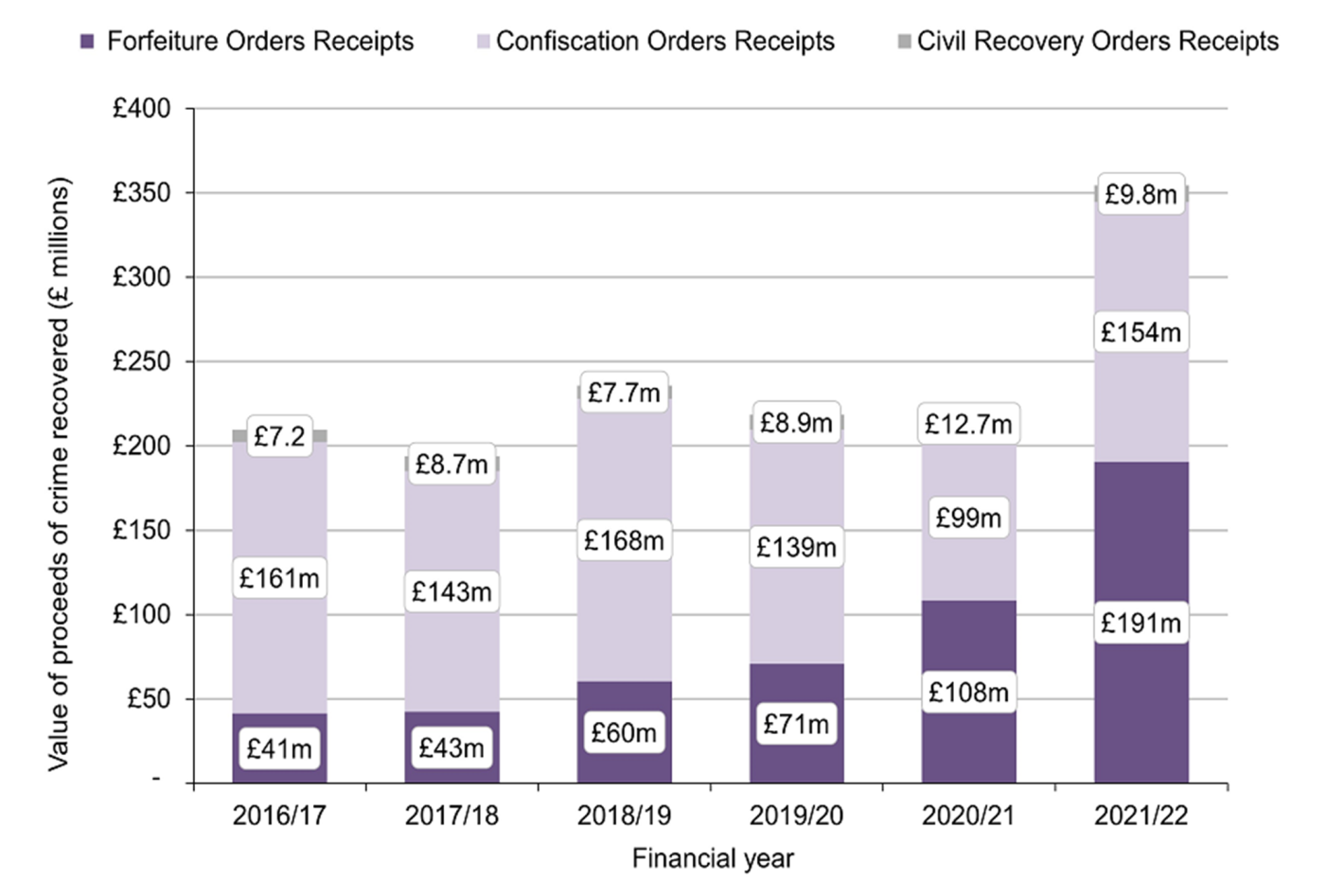
2021 – 2022 saw a substantial increase in the value of assets seized and recovered through Cash Seizures, Account Freezing Orders and Listed Asset Seizures.

In the 2021 – 2022 period, there was a 76% increase from the previous year in the amount of assets (£191 million) recovered by law enforcement agencies. 

The power for law enforcement agencies to apply for Account Freezing Orders was introduced under the Criminal Finance Act 2017.  Until recently, the UK has generally been slow to employ these powers.

We have, however, seen over the last few years, as confirmed by government statistics, a sharp increase in the number of account freezing orders being applied for and made.

The value of proceeds of crime recovered from Confiscation Orders, Forfeiture Orders and Civil Recovery Orders receipts from financial year 2016 to 2017 until financial year 2021 to 2022 in England and Wales, Northern Ireland jurisdictions and those which have no recorded jurisdiction[1]

You may be thinking that it is unlikely that you or your company would be subject to an Account Freezing Order; unfortunately, in our experience, that is not the case.

For example, we recently acted for 2 Chinese nationals residing in the UK in respect of an Account Freezing Order application brought by HMRC. The HMRC was seeking to freeze 6 bank accounts in total, which held approximately £150,000 for a period of 6 months so that they could carry out further investigations.

Our clients’ lives would have been drastically altered if they were unable to access any of their funds for 6 months, being unable to pay rent, travel to work, or pay for day-to-day amenities.

At the hearing, we were able to persuade the court to reduce the amount of time the accounts were frozen to 1 month only. Further, we were successful in dismissing one of the applications, meaning that an account with several thousand pounds remained unfrozen, which our clients could use to live their lives with minimal disruption whilst HMRC carried out their investigations.

In our experience, the first step towards successfully dismissing an Account Freezing Order application is to act without delay. The enforcement body will often look to have the hearing listed by the court shortly after making the application. It is therefore vital in our opinion that you make representation to the court as soon as possible.

What exactly is an Account Freezing Order? (AFO)

An AFO, is a civil order made in the Magistrates court prohibiting the withdrawal or payment from a bank account or building society by the operator of the account. The operator is generally the person or company named on the account.

The detailed provisions for applying for an AFO are set out in the Proceeds of Crime Act 2002.

The application can be brought by an officer of HMRC, a constable, a Serious Fraud Office officer, or an accredited financial investigator.

The circumstances in which an application would be made is where the officer has reasonable grounds for suspecting that money held in an account is recoverable property (generally being property obtained through unlawful conduct) or is intended by any person for use in unlawful conduct.

The officer is able to apply for the relevant account/s to be frozen for a up to 2 years. The officer can also apply to vary an AFO. So for example, if an AFO was initially granted for 6 months, an officer may apply prior to the end of the 6 months to vary the order, specifically to extend it for a number of months (up to 2 years).

It is important to note that the court may make exclusions regarding the prohibition on making withdrawals or payments from the account to which the AFO applies. The exclusions may include provisions allowing the individual to meet their reasonable living expenses or to carry on any trade, business, profession or occupation. An exclusion may also be made for a person to meet their reasonable legal expenses.

Unfortunately, the reality is that even in some cases where exclusions have been allowed, it can be a tedious and slow process for funds to actually be released from the relevant frozen accounts and as such, our solicitors attempt to dismiss the AFO application in the first instance.

It is also to be noted that any AFO application must be for a minimum amount of £1,000.

What if the AFO is granted?

If the AFO is granted, it is very likely that the officer will use the ordered prohibition time to carry out further investigations. At the end of the period, the officer will either allow the AFO to come to an end, and thus, the prohibition is immediately lifted, or the officer may apply to forfeit the money held in the frozen account.

If an application to forfeit the money held in the account/s is granted, this essentially means that the money will be taken from a person’s account and paid into the Consolidated Fund.

It is important to note that if money held in the frozen account is not forfeited, the individual subjected to the AFO can make an application to the court for compensation. The court must be satisfied that the individual has suffered loss as a result of the AFO and that the circumstances are exceptional.

Overview

AFO applications are on the rise; therefore, it is extremely important that if you receive an application, you deal with it swiftly.

The turnaround time between the application and the hearing is often short, so there is no time to delay. Simply letting an AFO be granted could see your bank accounts frozen for a period of 2 years.

The Dispute Resolution team at TV Edwards LLP are experts in dealing with AFO applications and are able to provide quick and tailored advice and assistance.

Should you require assistance regarding an AFO or Forfeiture application, please do not hesitate to contact us on 0203 440 8123 or at enquiries@tvedwards.com

[1] https://www.gov.uk/government/statistics/asset-recovery-statistical-bulletin-financial-years-ending-2017-to-2022/asset-recovery-statistical-bulletin-financial-years-ending-2017-to-2022#main-headlines

Frequently Asked Questions

What is the difference between an injunction and a freezing order?

The difference between an injunction and a freezing order is that an injunction is a broader legal tool that can prohibit or require someone to take a specific action, while a freezing order specifically prohibits a person or business from withdrawing or moving their funds or assets to prevent dissipation pending the outcome of a legal dispute or investigation.

How long does an account freezing order last?

An account freezing order in the UK can last for an initial period of up to 2 years. However, it can be extended by the court if necessary, based on the circumstances surrounding the investigation or legal proceedings.

TV EDWARDS SOLICITORS LLP

Success story: preventing an eviction

We successfully delay or prevent our client’s eviction.

Our Services Contact Us

Every day our solicitors act for clients who are at risk of losing their homes. In many cases we successfully delay or prevent our client’s eviction. This is one example, provided by housing solicitor, Natalie Thorpe.

When Mr S had a disagreement with his father and was being asked to move out of his home, he did not know what to do. Luckily for Mr S, google pointed him in our direction and because of our advice and assistance, a judge decided that he could not be evicted.

Some years ago, Mr S needed somewhere new to live. When considering his options, Mr S asked his father whether he could move into his two-bedroom flat. After some discussions, Mr S was allowed to move into the property and he took pride in making it his own. Unfortunately, Mr S and his father had a disagreement which led to Mr S’s father asking him to leave. Mr S then received a notice from the landlord (rather than his father), which referred to him as a “trespasser” at the property. The notice warned Mr S of the landlord’s intention to start a claim for possession against him at court.

Mr S wanted to stay in the property so he asked us for advice about what his rights were and if anything could be done to enforce them. Mr S was able to give us a lot of information about the agreement which he had with his father. We advised him that the landlord was not entitled to rely on this notice to seek possession of his home, because his father’s tenancy was still in existence. Instead, it was only his father who could take action to lawfully evict him from his home.

When the landlord issued a claim for possession we were able to grant emergency legal aid so that Mr S could be represented at court. At the hearing Mr S’s barrister argued that the landlord could not ask the court for a Possession Order against Mr S. The judge agreed and dismissed the landlord’s claim.

Throughout the case we had advised Mr S that although he could not be evicted based on the landlord’s notice, it was likely that eventually he would be lawfully evicted at some point (by his father). Therefore, Mr S was better able to plan for this eventuality and search for a new home.

Although it was not possible for Mr S to remain in the property indefinitely, as a result of our expert legal advice and representation he had extra time in his home and was given much longer to find alternative accommodation.

Disclaimer: The information on the TV Edwards website is for general information only and reflects the position at the date of publication.

TV EDWARDS SOLICITORS LLP

Top 10 reasons to make a Will

This article provides a general overview of the administration process and its key components.

Our Services Contact Us
TV Edwards Blog

If you haven’t yet made a Will, we’ve compiled the top 10 reasons to make a Will below:

Why Do You Need To Make A Will?

1. Distributing your estate in a tax-efficient way

Whether inheritance tax is due on your estate depends on the value of your estate and who inherits it.  If your estate is subject to inheritance tax, this can be reduced or mitigated entirely if your estate is distributed in a tax-efficient way in your Will. 

The intestacy rules distribute your estate to your closest relatives and do not take into account the impact this may have on the inheritance tax position.

2. Making provision for the care of your minor children

A Will does not only deal with the distribution of your estate but can also make provision for your children should you die before they reach adulthood.  You can appoint Guardians who will be responsible for the care of your children.

3. Making financial provision for your children

Without a Will, your children would automatically inherit your estate at 18, which some may consider too young to have access to significant sums of money.  You may prefer to create a trust for your children so that any monies they inherit are held in a trust and managed by trustees until they are mature enough to manage their inheritance.

4. Making provision for your partner

The intestacy laws are based on the traditional perception of family. Even if you’ve spent 20 years with your partner, if you are not married or in a civil partnership, they will not be entitled to your estate if you do not make a Will.

With a will, you can make provision for your partner or any other person who would not otherwise inherit from your estate.

5. Reducing the risk of family disputes

Making a Will allows you to choose who will be responsible for administering your estate as your Will will appoint Executors, people you trust, to carry out your wishes. 

A professionally drafted Will reduces the risk of a dispute arising in relation to who should deal with your estate, which can also reduce the time taken to administer your estate.

A professionally drafted Will also reduces the risk of a dispute arising in relation to the distribution of your estate.

6. Providing a home for someone using a trust

If you own property or a share of the property, you can, in your Will, give a loved one the right to live in that property without actually giving them the property. For example, you may wish to give your partner the right to live on your property for as long as they need a home, but when they no longer need to live there, you may wish the property to pass to your children.

7. Supporting a charity

You can, in your Will, make provision for a charity that you wish to support.

Not only will this benefit the charity (charities rely heavily on donations and legacies), but this can also reduce the inheritance tax due on your estate if your estate is taxable, as charities are exempt from inheritance tax.

8. Making provision for your pets

If you have a pet, you can decide in your Will who should be responsible for their care if they outlive you and perhaps leave a legacy to this person to help towards the cost of caring for your pet.

9. Making funeral arrangements

Following a bereavement, families can often disagree on whether to bury or cremate and where the burial or cremation should take place.  Making a Will allows you to make it clear what your choice is so there can be no disagreement about this following your death.

10. Making provision for close friends

If you do not have close family and you die without a Will, your estate will pass to distant relatives on your death, which may not be what you would have chosen. 

In such cases, your distant relatives will need to be located, and the cost of this can be considerable.  Making a Will means that you can make provision for whoever it is that you want to inherit your estate, which is likely to reduce the costs of administering your estate.

For more information about Wills and Probate, click here.

Disclaimer: The information on the TV Edwards website is for general information only and reflects the position at the date of publication.