If you are thinking of issuing or have just issued a claim in the Courts, you need to consider allocation and how that may affect your case. Read on to find out more about the allocation process and the different ‘tracks’ in the courts.
What is allocation and when does it take place?
Allocation is the process by which a judge decides which procedural ‘track’ your claim belongs to. This is an important part of a judge’s case management powers, as proper allocation leads to the best use of available time and resources for all parties involved.
Allocation takes place after the claim has been issued and served and the Defendant has established that they will defend the claim. At this point, the parties will be served with a Notice of Proposed Allocation, stating the track which provisionally appears to be the most suitable for the claim. The parties will also be asked to complete a Directions Questionnaire. Your legal representative can help you complete this form.
Once the Directions Questionnaires have been filed with the court, the claim will then be allocated.
How does the court allocate claims?
A judge will decide which track a claim should be allocated to based on various factors, including:
The financial value of the claim
The remedy sought by the Claimant
The complexity of the claim
The number of parties and witnesses
The need for expert evidence
Some claims are automatically allocated to the Multi-track. These include claims made in the Commercial Court and claims made under Part 8 of the Civil Procedure Rules (CPR).
What are the different tracks and what difference does it make for me?
There are three different tracks: the Multi-track, Fast track and Small claims track.
Multi-track
This is generally the appropriate track for claims where the financial value of the case is more than £25,000 and the trial is expected to last longer than one day. These claims can be heard in either the High Court or the County Court.
Cases allocated to this track are usually more complex and as such the applicable procedures allow for more flexibility.
Fast-track
This is generally the appropriate track for claims where the financial value of the case is between £10,000 and £25,000. For most cases, trial would not be expected to last longer than a day. These claims are usually heard in the County Court.
Small claims track
This is generally the appropriate track for claims where the financial value of the case is below £10,000. This track has a simplified procedure compared to the Multi-track and the Fast track, making it easier for litigants in person.
What difference does it make for me?
One of the most important consequences of allocation is the recoverability of your incurred costs in proceedings. In the Small claims track, generally speaking the recoverability of costs is extremely limited. If you are thinking of making a claim that would be allocated to the Small claims track, you would need to carefully consider if the remedy you seek is worth the costs you would incur for the court process.
How do I know which track my claim has been allocated to?
Once the Court has allocated the claim, each party will be served with a Notice of Allocation. This will confirm which track your claim has been allocated to and the steps you need to take next.
What happens if my claim is not allocated to the right track?
The Directions Questionnaire has not been completed properly
If you have not provided the correct information in the Directions Questionnaire and this has led to the Court allocating your claim to the wrong track, you may need to contact the Court and re-file the Direction Questionnaire. You also need to be aware of any potential costs sanctions you could face.
The Court has made an error in allocating my claim
Your claim may not have been allocated to the correct track due to an administrative error by the Court. You can write to the Court in this situation to rectify the mistake, however this can lead to delays in time and increased costs. To avoid this, it is always best to make sure you check that the claim has been properly allocated when you receive the Notice of Allocation.
More Information
At TV Edwards, our Dispute Resolution solicitors are experts in all aspects of civil procedure and litigation. We are able to guide you through the process of allocation and assist with all steps, such as completing the Directions Questionnaire and filing this with the Court. If you would like to find out more about the services we can offer you, please contact the Dispute Resolution team at TV Edwards Solicitors LLP.
Settlement Agreements are legally binding contracts which codify the legal intentions of two or more parties and ensure compliance through enforceability, i.e. if one party reneges on the terms of the agreement, another party can sue for breach of contract.
Types of Settlement Agreements
The two most common types of Settlement Agreement include:
Agreements used to terminate employment contracts
Agreements used to legalise offer and acceptance in litigation, not done via Civil Procedure Rule (CPR) 36.
Formerly known as compromise agreements, they are used to end an employee’s employment; there is an agreed upon quid pro quo, where the employee agrees not to sue and in return the employer agrees to make a payment, usually in excess of their statutory requirement. These types of agreement are often used when voluntary redundancy is offered and taken; and if accepted, the employee might be asked to leave the workplace immediately, being placed on gardening leave. The employee will also be required to waive all claims against the employer, save for any personal injury, so it is vital that the employee consider the circumstances of their employment being terminated very carefully.
The Employment Right Act 1996 governs Settlement Agreements, and the agreements themselves will generally dictate that independent legal advice is sought by the employee, before the agreement can be fully executed. This advice will likely be paid for by the employer.
Offers to settle litigation can be made via CPR 36 ‘Part 36’ and ‘Calderbank’ offers. Part 36 offers have set rules regarding costs, prescribed by the CPR, but Calderbank offers have no such framework; these types of offers will usually require detailed settlement agreements setting out terms to ensure settlement is full and final and fully enforceable.
Next steps
If your employer has offered you voluntary redundancy and has presented you with a settlement agreement, please seek legal advice; our diligent team at TV Edwards Solicitors will happily assist and there will be no additional cost to you; our full fee will be covered by your employer’s contribution. Alternatively, if you have a claim currently being litigated, please consider the benefits of compromise and settlement, and a properly drafted Settlement Agreement. At TV Edwards Solicitors our experienced lawyers can guide you in the drafting of Settlement Agreements, and all other aspects of the litigation process.
For lots of people, the first time that they become aware of the Court of Protection is when they face the prospect of a court case in relation to themselves or a loved one. It can be overwhelming, especially because when people think about a court, they often imagine criminal courts where Judges and barristers wear gowns and wigs and the Court is deciding whether or not someone is guilty. People can also find it difficult to get to grips with what is happening because the language used to talk about the issues in the case can be unfamiliar.
The Court of Protection is a Court which is dedicated to making decisions on financial matters or welfare issues (such as where someone might live or what care they might receive) for people who cannot make decisions at the time they need to be made i.e. because they lack mental capacity to do so.
The person at the centre of proceedings in the Court of Protection is referred to as ‘P’. The first thing the Court of Protection has to decide is whether P has the mental capacity to make the decision at the centre of the case and if they do not, the Court then has to decide what decision is in that person’s best interests and is the least restrictive option for them.
What does it mean to lack capacity?
What do we mean when we say someone lacks mental capacity? “Capacity” means whether someone is able to make their own decision about something. The law says that someone will lack capacity if they are unable to make a decision for themselves in relation to the matter because of an impairment of, or disturbance in the functioning of, the mind or brain.
When considering if someone is unable to make a decision for themselves, you have to consider whether the person is unable:
(a) to understand the information relevant to the decision,
(b) to retain that information, (so whether someone can remember it)
(c) to use or weigh that information as part of the process of making the decision
(d) to communicate his decision (whether by talking, using sign language or any other means).
Their inability to do one of these four things has to be because of a condition that affects their mind or brain for example, dementia or a learning disability. It is, of course, not the case that everyone with a condition affecting their mind or brain will lack capacity.
What can the Court of Protection do?
The Court of Protection has the power to make orders in relation to a person’s welfare, specifically including:
Deciding where P should live;
Deciding what contact, if any, P should have with other specific people (such as family members, friends etc);
Preventing a specific person from having contact with P;
Giving or refusing consent to the carrying out or continuation of treatment by a person providing healthcare for P;
Giving a direction that a person responsible for P’s health care allow a different person to take over that responsibility.
Therefore, if anyone wants to make a decision on P’s behalf (for example where P should live) or they disagree with the public body about what decision should be made in P’s best interests or obtain clarification about a particular issue, they can apply to the Court of Protection who can:
Make a declaration about whether P can make a particular decision herself and whether an act or proposed act to be taken in respect of P is lawful;
Make an order to make the necessary decisions on P’s behalf or appoint someone else (called a ‘deputy’) to make those decisions for her.
When considering whether to make a decision, the Court of Protection has to refer to five principles:
A person must be assumed to have capacity to make a decision unless it has been established that they lack capacity (i.e. the starting point is always that someone can make their own decisions until there is evidence demonstrating otherwise).
A person is not to be treated as unable to make a decision unless all practicable steps to help him have been taken without success (i.e. can the decision be explained to them in a different way to assist them in making the decision?)
A person is not to be treated as unable to make a decision merely because he makes an unwise decision.
Any act or decision made must be in the best interests of the person who lacks capacity i.e. any decision the Court made about P would have to be in her best interests.
Any action taken must be achieved in a way that is least restrictive to P’s rights and freedom of action i.e. any decision the Court made about P would have to be a decision that would have least impact on her but still be in her best interests.
The most important two for the Court to consider are ‘best interests’ and ‘least restrictive’.
When considering a person’s best interests, the Court of Protection has to take into consideration all the relevant circumstances. This includes whether in the future that person may regain capacity to make a decision, what that person’s past and present wishes and feelings are, their beliefs and values that are likely to influence their decision and any other factors that the person would be likely to consider if they had capacity. The Court should also consult with other people such as anyone engaged in caring for that person or who is interested in their welfare.
The Court does not however have to make a decision in accordance with either the person’s wishes and feelings or the position of people who are interested in their welfare if overall it would not be in that person’s best interests.
The Court of Protection is a forward-looking inquisitorial court. This means that the Court’s role is not simply to decide who is right and who is wrong but to engage in the process of considering what evidence is required to help it make a final decision and what options are available for P. P is at the very heart of the proceedings and the emphasis is on everyone working together to reach an outcome that is in P’s best interests. Judges and barristers in the Court of Protection do not wear robes (unless the case is in the High Court) and Judges often meet P (if P would like to meet them) to hear from P directly about what they want.
The Court of Protection team at TV Edwards can represent you or a loved one in any welfare issue in the Court of Protection. Please contact us on 020 3440 8000 or a_courtofprotectionreferrals@tvedwards.com to make an enquiry.
Arbitration is a form of alternative dispute resolution. It is another way of resolving your dispute and in some cases will be more cost effective and speedier than issuing traditional litigation proceedings in court. Most types of commercial disputes can be arbitrated, however, the parties must agree to arbitration rather than court proceedings as a way of resolving the dispute.
How is arbitration different from traditional court litigation?
Arbitration is generally considered to be more flexible than traditional court litigation as the parties can choose the arbitrators. Usually, the contract or agreement setting out the business relationship between the parties will contain an arbitration clause, which sets out under what conditions an arbitration can be initiated to resolve a potential dispute.
Below we set out some of the key differences between arbitration and traditional court litigation:
Arbitration
Traditional
Parties can nominate their own arbitrators based on expertise
Parties have no say over the which judge will preside over their case
More flexibility in terms of procedure
Procedure tends to be stricter and hearing risks being struck out if deadlines are not adhered to
Administered by an arbitral institution
Administered by a court
Hearings are confidential
Hearings can be open to the public
Resolution may be reached faster
Resolution may take years, especially if the court is facing an administrative backlog
After hearing, arbitrator produces an arbitral award
After hearing, judge produces a court judgment
Arbitral award is usually final and cannot be appealed
Court judgment can be appealed
Who administers arbitral proceedings?
Arbitration does not take place at court. Instead, it is administered by arbitral institutions, which may have their own arbitral rules. The arbitral institutions can also help appoint arbitrators where parties are not able to come to an agreement.
Here are some arbitral institutions that administer arbitrations seated in the UK:
Royal Institute of Chartered Surveyors (RICS)
The RICS is a professional body specialising in matters concerning land, property and construction. As part of their dispute resolution services, they offer arbitration proceedings and can appoint a suitable arbitrator with expertise in the field relating to your dispute. RICS-certified arbitrators must pass a series of assessments to ensure a high professional standard is maintained.
London Court of International Arbitration (LCIA)
The LCIA specialises in administering commercial arbitration, with the top industry sectors of the LCIA’s caseload being banking and finance, energy and resources, and transport and commodities. The majority of parties in LCIA arbitrations are based overseas but many of these wish to apply English law to their arbitral proceedings. The LCIA has a large database of arbitrators from different nationalities and with different areas of expertise, allowing them to appoint appropriate arbitrators to each arbitration.
International Chamber of Commerce (ICC)
The ICC is based in Paris however it is an international institution and can administer arbitrations seated in the UK. The ICC promotes international trade, responsible business conduct and a global approach to regulation. Like most arbitral institutions, in order to initiate arbitral proceedings at the ICC, the claimant must submit a Request for Arbitration with the Secretariat of the ICC.
Under what circumstances would arbitration be better for my case?
International disputes
If you are thinking of bringing a claim against a foreign company, you may prefer to initiate arbitration proceedings. Arbitration is well-suited to any disputes with an international dimension. This is primarily because a foreign party may object to proceedings in a national court, which could be seen to favour the party who is a national of that country. Arbitration is more ‘international’ as the place of arbitration can be agreed upon by the parties.
Confidentiality
In traditional court litigation, hearings are usually open to the public and judgments are usually published for anyone to access. However, in arbitration the tendency is towards confidentiality. If you are concerned about protecting your business’s reputation and public image, the confidentiality offered by arbitration proceedings may be more attractive for you.
In March of this year, the UK government introduced this legislation as a way of dealing with disputes over unpaid rent for commercial leases during the COVID-19 pandemic. The primary purpose of the Act is to encourage disputing parties to use arbitration as a way of resolving their disputes in this area. For more information, please see our blog post on this topic.
Arbitration Act 1996
The Law Commission of England and Wales announced in November 2021 that they would be conducting a review of the Arbitration Act 1996. If necessary, recommendations for reform will be made however the Act is generally viewed as not being in need of a major overhaul. Instead, the purpose of the review is to ensure that the UK remains an attraction place of arbitration for disputing parties.
Contact us
At TV Edwards, our Dispute Resolution solicitors are experts in all aspects of ADR including arbitration and are able to provide you with advice on your matter. From helping you decide whether arbitration or court litigation would be better for your case to finding an appropriate arbitrator, we can help you every step of the way. If you would like to find out more about the services we can offer you, please contact the Dispute Resolution team at TV Edwards Solicitors LLP.
In this article Anesha highlights the difficulties that divorced and divorcing couples face, following the Bank of England’s interest rate rise and inflation warnings.
With interest rates rising and recession predicted, the Office for National Statistics has announced that the Retail Prices Index (RPI) has increased 11.8% in the year to June 2022, the biggest increase since January 1982. The National Institute of Economic and Social Research think tank predicts the RPI could reach 17.7% by the end of the year. This is hugely difficult for all consumers, but has particular significance for divorced and divorcing couples.
The regular monthly payments often paid by one former spouse to the other, known as spousal maintenance, are often expressed to include an automatic review of the amount being paid each year to ensure spousal maintenance increases is in line with inflation.
The most common way this is done is to include a provision in the court order to link the inflationary review to the performance of the RPI. This means that if you are the receiving former spouse you will get some help to meet the rise in cost of living. On the other hand, if you are the paying spouse you will have to pay more, even if your own expenses have increased and your income has not.
An increase to maintenance based on the RPI is worked out by comparing the most recent RPI with that of a year previously therefore a sharp rise can lead to unprecedented changes in the carefully balanced arrangement of a former couple’s incomes.
Sometimes the paying spouse cannot afford an increase in spousal maintenance payments. In this scenario they could apply to court to vary the spousal maintenance order downwards based on the change of circumstances. Alternatively, if a paying spouse does not pay the increased rate despite a request based on the RPI, it may be necessary to apply to court to enforce the higher sum.
At TV Edwards we can advise on the calculation, variation and enforcement of maintenance payments. We are proud to be valued advisers for our clients when times are tough. Please get in touch so we can help you.
In the government’s own words, this “will make home ownership fairer and more transparent for millions of future leaseholders”.
What issue does the Act try to address?
As covered widely in the media, there have been concerns about the impact on the value of leasehold properties where the lease contains provisions for periodic increases in ground rent, often referred to as ‘escalating ground rents’.
The concern is that the ground rents demanded by landlords often end up being far greater than would be expected for what was originally intended to be a simple rent for the use of the ground on which a property is built. Concerns also surround a technical legal argument (as yet unresolved) that might unwittingly mean that a lease becomes a mere Assured Shorthold Tenancy due to a loophole in the if a leaseholder fails to pay the ground rent for a certain period. No doubt, some readers have already experienced the delays this can cause to a conveyancing transaction as sellers try to negotiate less onerous ground rent terms with landlords in order to satisfy mortgage lender requirements.
What does the Act do and what does this mean for you?
The good news is that from 30th June 2022, landlords of regulated leases must not require a leaseholder to pay a ground rent of more than “one peppercorn per year”, effectively capping ground rents to zero financial value.
Regulated leases covered by the Act include:
Leases granted on or after 30th June 2022
Long leases exceeding 21 years for a single dwelling
Leases granted for a premium (or a ‘purchase price’) but this does also include leases which have been varied by a ‘deed of surrender and regrant’ and no premium was paid.
Leases that are not excepted leases
Statutory Lease Extensions for flats must already be granted a peppercorn ground rent notwithstanding this Act.
Where does the Act’s peppercorn limit not apply?
It is important to note that the Act does not apply to leases already in existence prior to the 30th June 2022 and therefore, while the Act is a significant first step in making ground rents fairer for future leaseholders, we would welcome further measurements from the government to provide more equitable leases for all.
In addition, the Act will also not apply to voluntary (or non-statutory) lease extensions in which the landlord will be entitled to retain the existing ground rent until the remainder of the original lease term has expired.
The Act will also not apply where:
A lease is not a regulated lease
A buyer and seller have entered into a contract for the grant of a lease before the 30th June 2022, even if the lease itself is granted after 30th June 2022
Leases are for community-led housing, certain financial products and business leases
The lease is a shared ownership lease where the rent is paid on the landlord’s owned share; the peppercorn limit will only apply to the leaseholder’s owned share
It should also be noted that the Act will not apply to regulated leases of retirement homes until 1st April 2023 at the earliest due to a transition period which is in place for such properties.
What should I do if I am a leaseholder or a landlord?
Whether you are a prospective purchaser of a leasehold property, a leaseholder looking to extend your lease or challenge an illegal ground rent, or a landlord keen to ensure that you are complying with the new legislation, our Property and Dispute Resolution teams at TV Edwards are well equipped to provide you with the legal expertise you need to take the best course of action for your circumstances.
If you have any questions or require any assistance on any of these issues, please contact Juanita Francis at juanita.francis@tvedwards.com (Property expert) or our Dispute Resolution team or either of the two on 0203 440 8000.
The appeal concerned care orders made in relation to three children with care plans for their removal from their mother’s care into separate long term foster placements. The threshold criteria centred around one of the children having been sexually abused by an adult half sibling, a risk of future sexual harm and a failure to protect the children by their parents.
The Supreme Court distilled the central issue of the appeal to be:
In making care orders for the removal of three of the first appellant’s children into foster care:
The proportionality question: In order to decide whether those orders were proportionate, was it necessary as a matter of law to assess the likelihood that, if left in the first appellant’s care, (a) the children would suffer sexual harm; (b) the consequences of such harm arising; (c) the possibility of reducing or mitigating the risk of such harm; and (d) the comparative welfare advantages and disadvantages of the options presented; and
The balancing exercise question: Did the judge err in law by failing to make any or any proper assessment of those matters?”
It was set out that there were three stages for a judge to consider in most applications for a care order namely:
Finding the relevant primary facts;
Determining whether the legal threshold for the making of a care order has been crossed (section 31(2)(a) Children Act 1989); and, if yes, then
Deciding the proper order to make (the disposal or welfare stage).
Analysis of potential orders
It was not argued that the assessment of the risk of harm to the children in their mother’s care was wrong, but that the judge at the first instance failed to consider at the third of these stages whether making care orders removing the children from their mother’s care was a proportionate response to that risk. It was argued that to assess this it was necessary to consider the harm the children would suffer as a result of being removed from their mother and placed in separate placements with limited contact against their wishes. This required a clear analysis of other potential orders which could be made. It was also relevant that a non-molestation order was in place which prevented the adult sibling, amongst other things, from returning to the family home.
The family courts already have clear authority that a care order should only be made if it is necessary. The case of Re B (A Child) (Care Proceedings: Threshold Criteria) [2013] UKSC 33 restated the longstanding provision in English family law that the aim of the court must be to make the least interventionist order possible. The case of Re B-S (Children) (Adoption Order: Leave to Oppose) [2013] EWCA Civ 1146 adopted the analysis of McFarlane LJ (as he then was) in Re G:
“The judicial task is to evaluate all the options, undertaking a global, holistic and … multi-faceted evaluation of the child’s welfare which takes into account all the negatives and the positives, all the pros and cons, of each option …
‘What is required is a balancing exercise in which each option is evaluated to the degree of detail necessary to analyse and weigh its own internal positives and negatives and each option is then compared, side by side, against the competing option or options.’”
Judgment
What the Supreme Court considered in this case was that although the judge’s consideration of the facts and evidence was thorough and he directed himself that his orders must be proportionate, he did not go far enough. There must be a critical side-by side analysis of the available options before the Court and an evaluative holistic assessment as set out in Re B-S.
“Whilst the judge has identified the risk of sexual harm as satisfying the threshold criteria for intervention, there is no evaluation of the extent of the risk of significant harm by way of sexual harm, nor of any available means by which the risk might be reduced for each child. Nor is there any comparison of the harm which might befall the children if left at home with the harm which would be occasioned to them if removed and separated not only from the parents but from each other.”
“…The process adopted by the judge is flawed as it did not adequately assess the prospects of various options to mitigate the risk of sexual harm. The judge does not state why the emotional damage that each of the very different subject children would suffer under a care plan which separated them from their mother, from their stepfather and no less importantly from their siblings, was proportionate to and necessitated by the identified risk of sexual harm from A, when no instances of harm had occurred since November 2019 and where a protective framework of non-molestation and interim supervision orders was in place.”
What can we take from the judgment?
This case is significant and will require judges to consider and carefully articulate in any future judgment where care orders are made:
The risk
The extent of the risk
Any means by which the risk could be reduced
A comparison of the harm should the child remain at home with the harm caused as a result of removal
That any identified harm of removal from the family unit is proportionate to and necessitated by the risk of harm identified at 1-3 above
TV EDWARDS SOLICITORS LLP
Legislative changes affecting same sex couples, and their impact on family formations
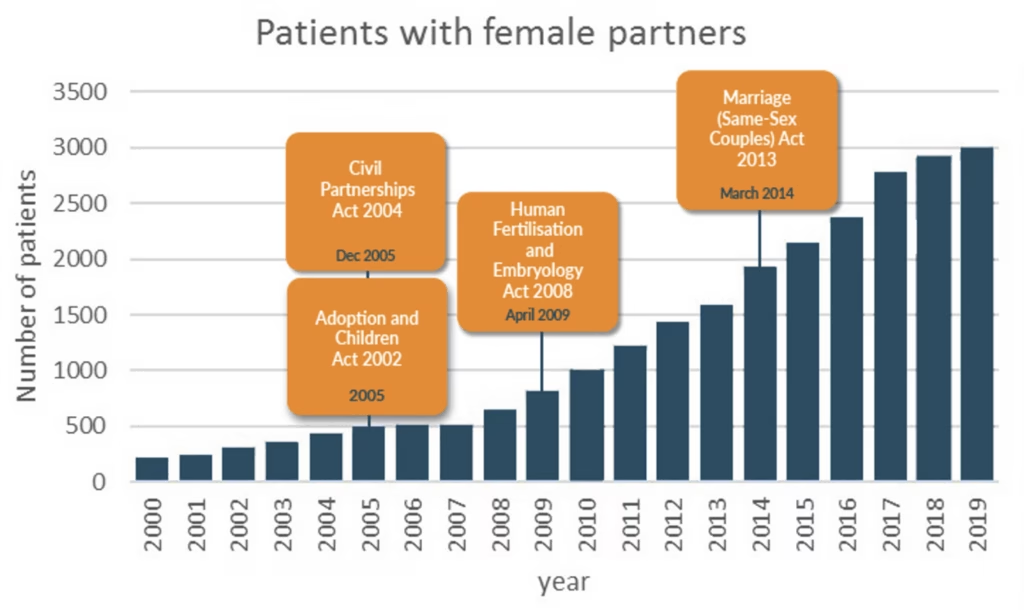
In December 2005 we celebrated the commencement of the Civil Partnerships Act 2004and later that month the fact that unmarried couples including same sex couples were able to adopt jointly following the commencement of the Adoption and Children Act 2002.
On 6 April 2009 the parenthood provisions of the Human Fertilisation and Embryology Act 2008 came into force allowing a child to have two female parents from birth. The same act allowed same sex couples to apply for parental orders, thus allowing same sex couples to build their families through surrogacy.
Gay marriage was introduced in England and Wales by the Marriage (Same-Sex Couples) Act 2013 with the first same sex marriages taking place on 29 March 2014.
Summary of Key Legislative Changes:
Whilst each of these legislative changes were welcomed as long overdue, I wanted to look at the impact of these on family formations. To do this my research has explored changes in couples receiving fertility treatments, using surrogacy, as well as adopting.
The HFEA publishes UK statistics for IVF and donor insemination (‘DI’) treatment, storage, and donation.[i] The most recent statistics were published in May 2021. The Ministry of Justice publishes Family Court Statistics Quarterly, giving National Statistics on activity in the family courts of England and Wales.[ii] The two sets of statistics cover different geographical areas and do not include assisted reproduction taking placed outside of a HFEA licensed clinic.
Fertility treatment for female same sex couples in HFEA licensed clinics
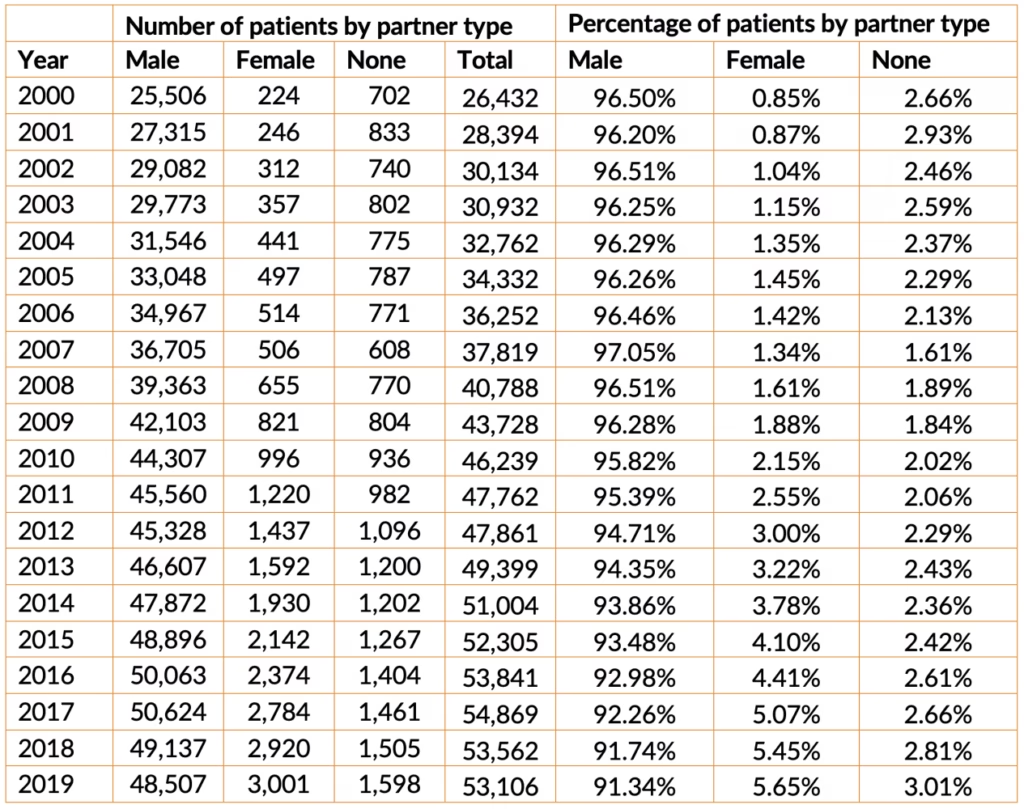
The HFEA looks at patients and treatment cycles by partner type, which includes surrogates and distinguishes between IVF cycles and DI cycles. The data has become more accurate over time. In 2000 there was no partner type recorded in relation to 3,226 IVF patients, by 2007 no partner type was recorded for only 79 and this reduced to less than five in 2012.
I decided to look at how the patient demographic changed. For the purposes of analysis, I have excluded the patients where no partner type is recorded as well as those where surrogates are recorded. I combined IVF and DI patients.
In 2008, before the implementation of the female parenthood provisions of the Human Fertilisation and Embryology Act 2008, there were 655 patients with female partners. This increased to 996 the first complete year following the implementation and since then, the number of patients with female partners has more than tripled to 3001with the percentage of patients with female partners rising from 1.61% to 5.65%.
Surrogacy
Whilst the HFEA has statistics about surrogacy patients and cycles, they do not record the gender of the intended parents.
In 2009 before the introduction of the surrogacy provisions of the Human Fertilisation and Embryology Act there were 139 surrogacy patients, in 2011 there were 159 surrogacy patients, this increased to 255 by 2019. The number of cycles for the same period were 166, 196 and 325.
Of course, treatment will not be successful in all cycles nor for all patients. It is also important to note that many intended parents travel abroad for surrogacy. Those arrangements will not be included in the HFEA statistics. Parental orders are necessary for intended parents to secure parentage following surrogacy arrangements. The Family Court Statistics show 117 parental orders were granted in England and Wales in 2011, rising to 444 in 2019.
The Law Commission and Scottish Law Commission consultation paper “Building families through surrogacy: a new law” records “information provided by CAFCASS dated 7 October 2015 in response to a Freedom of Information Request, which showed that, of 229 parental order applications made in 2014, 172 were made by opposite-sex couples, and 56 made by same-sex couples, compared to 92 opposite-sex couples and 1 same-sex couple in 2010”.
Adoption
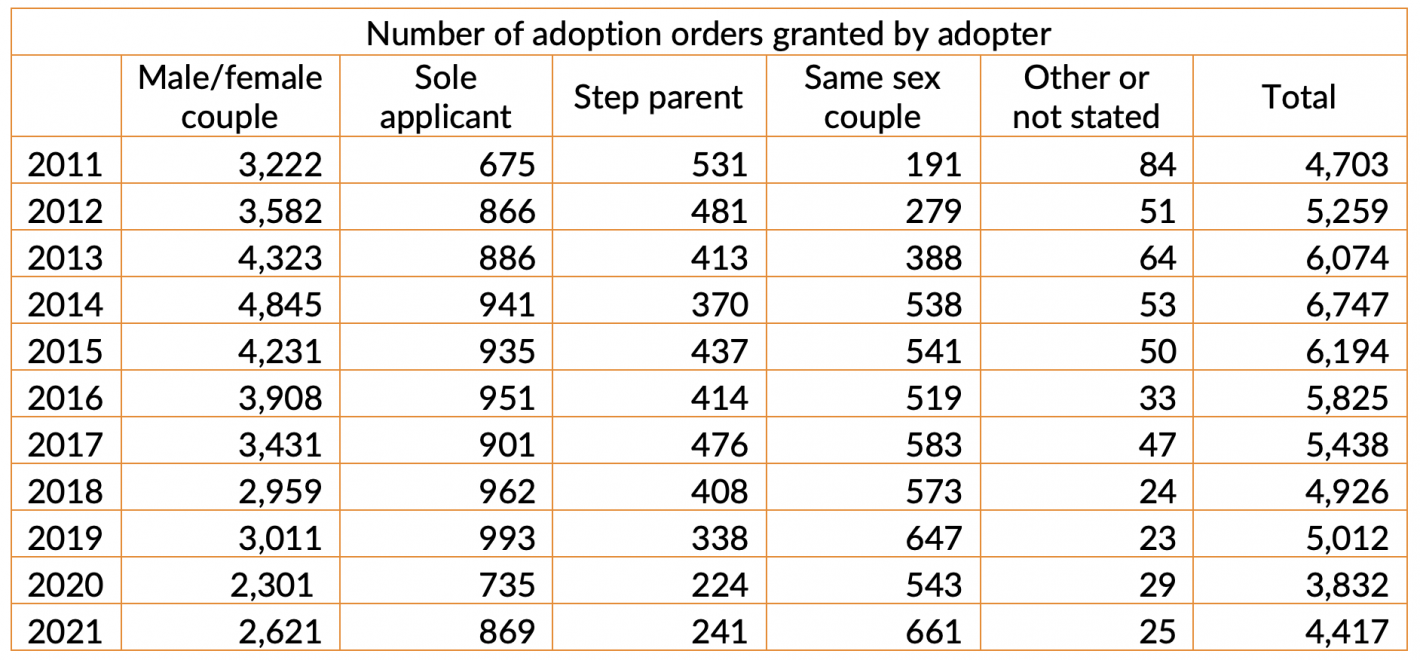
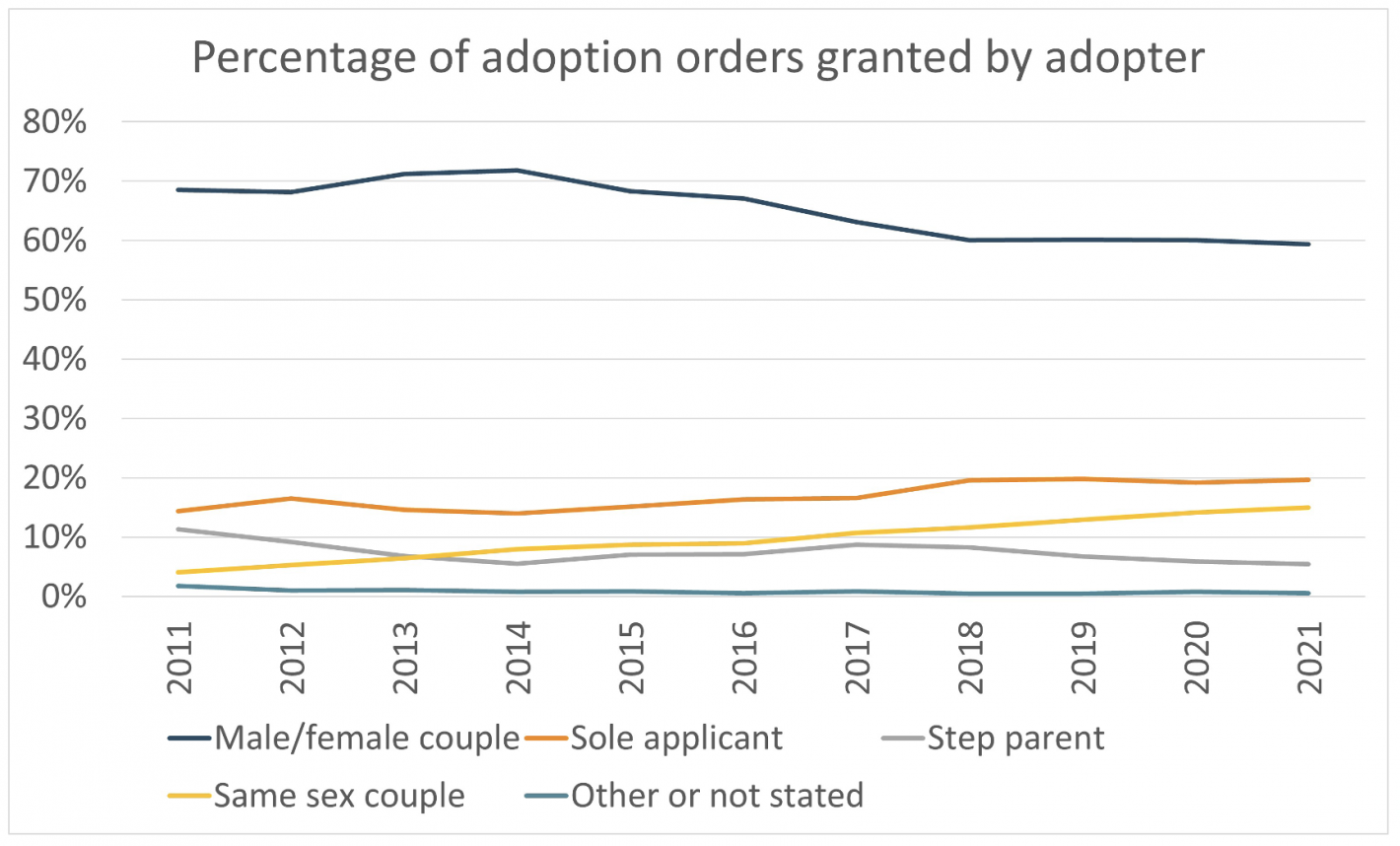
In terms of adoption, the number of same sex couples adopting has also tripled over time.
The adoption statistics include step parent adoptions where the gender of the couple is unknown, if these adoptions and those where the adopter was other or not stated, same sex couples accounted for 15.92% of adoptions in 2021, an increase from 4.67% in 2011.
ONS statistics[i] show that in 2019 the proportion of women identifying as heterosexual or straight was 93.9%, 1.1% of women identified as gay or lesbian and 1.6% as bisexual. Younger women are more likely to identity as being gay or lesbian, but the subsets of data do not easily correlate with the age of fertility patients. The HFEA statistics only identify the gender of a woman’s partner at the time of treatment and not their sexual orientation and so it is impossible to compare data accurately.
In the United Kingdom, Pride has additional significance given the history of Section 28 of the Local Government Act 1988, which banned the promotion of homosexuality by local authorities. This legislation was not repealed until 2000 in Scotland and 2003 in England and Wales.
Today, Pride Month serves as both a celebration of LGBT+ rights and a reminder of the ongoing challenges that many in the community face.
It highlights the progress made through legislative change, such as the Civil Partnerships Act 2004, the Marriage (Same-Sex Couples) Act 2013, and reforms to adoption and surrogacy law. It also provides a platform to continue raising awareness of the legal rights of same-sex couples and same-sex family law, ensuring that equality is embedded both legally and socially.
For TV Edwards, acknowledging Pride Month is about more than celebration; it is about recognising the link between history, legislation, and lived experience. By reflecting on LGBT+ UK history alongside the continuing evolution of same-sex family law, we are reminded that progress in rights is not automatic but earned through advocacy, reform, and visibility.
Conclusion
The statistics outlined above evidence the real and positive impact arising from the legislative changes including: the commencement of the Civil Partnerships Act 2004, Adoption and Children Act 2002, the Human Fertilisation and Embryology Act 2008, and the Marriage (Same-Sex Couples) Act.
The research clearly illustrates that these key legislative changes have already led to significant increases in same sex couples expanding families, whether this is achieved using IVF, DI, surrogacy or adoption.
“It does not come as a surprise to me that we are edging towards a similar proportion of female same sex couples seeking to expand a family through fertility treatment as opposite sex couples with fertility issues. Whilst the figures for adoption remain comparatively small, same sex couples are now more likely to look to adoption. It is wonderful to see the continuing positive power of legal and societal changes. However, there is still room for improvement such as clinical commissioning groups reviewing and updating their funding policies. Official forms should be updated so that they do not simply refer to mother and father, they should enable a child’s parentage to be accurately recorded.”– Anest Mathias
How TV Edwards Can Help Same-Sex Couples
At TV Edwards, we combine our long history in family law with specialist expertise in LGBT+ rights and same-sex family law. Our Family Law solicitors advise on every aspect of same-sex couples’ legal rights, from civil partnerships and marriage to adoption, surrogacy, fertility law, and parental orders.
We understand that the legal framework can feel complex, particularly when navigating sensitive issues around family formation. Our role is to provide clarity, reassurance, and tailored advice that reflects both the law and the unique circumstances of each client.
Whether you are considering adoption, exploring fertility treatment, entering into a surrogacy arrangement, or simply want to know more about your rights, our team can guide you through every step. We are committed to ensuring that all families receive the recognition and protection they deserve.
About TV Edwards
TV Edwards was established in 1929 we enjoy a national reputation for delivering first-class legal services. Many of our lawyers are renowned legal experts; they train the profession, and they publish. Together our teams provide the legal support and expertise to help clients get resolution as quickly and as inexpensively as possible.
Anest Mathias is TV Edward’s expert in fertility, surrogacy and modern parenting law. In her role as a lawyer, she advises heterosexual and same sex couples as well as individuals seeking to create their family.
Anest qualified as a solicitor in 2005 and advises married and unmarried couples on all aspects of private family law. She has a broad range of experience in divorce and separation including finances upon divorce, financial provision for unmarried couples and children and disputes as to the ownership of property.
Seeking to own property in England and Wales is usually one of the largest financial decisions a person can make. It involves years of savings, hard work and investment either alone or with family/a partner.
Where there is more than one owner of property, there will be a trust of land in place. While it might be clear from an inspection of the title deeds how property is owned, it is not always as clear how the beneficial interest (the equity in the property) is held.
With costs of living rising, there are a number of different ways to seek to purchase a home – but what happens when someone wishes to challenge their share in the ownership?
This article seeks to talk about common ways that property can be owned and some of the pitfalls that their loved ones may fall into.
Existing Owner Disputes
There is a longstanding line of caselaw which exists as a result of one landowner seeking to make arrangements or a person they met when they owned their property before this person entered their life. Disputes can often occur after the legal owner dies, especially if the other person’s interest was never formalised by entry into the title deeds (say, because there is a lender, and the other person had a poor credit rating).
Trusting One Another – Constructive Trusts
In these types of situations, if the beneficiaries of the owner’s estate seek to exclude you from the property or sell it and not provide you any sums, you could seek to prove you have a ‘constructive trust’. The most common way these arise is when there is a clear common intention between the parties and their intention is that they would both own the property. What is very important here is that not only is the intention clear, but the extent of the proposed ownership is clear. Having a written expression of this interest is often one way to go about establishing this.
A Promise is a Promise
Another way you could seek to establish an interest is through a practice called ‘promissory estoppel’. This is where a Court acknowledges that a promise was made to a party which was relied on to their detriment and would be unfair to prevent the follow-through of. These situations, as compared to constructive trusts, can be unilateral but still require the element of certainty as to what exactly was promised and on what terms.
Fiancé Fixer-Uppers
Another way that those who are engaged or married can seek to establish a beneficial interest in a property is provided by parliament under section 37 of the Matrimonial Proceedings And Property Act 1970.This states that contributions made by a spouse (or to a fiancé) of either money or similar worth to the improvement or property in which either of them have an interest is presumed to similarly be for the acquisition of an interest in that property.
For these types of claims, the court would determine (in default of any agreement) what the fair portion of the equity would be, subject to a number of other factors which would need to be accounted for.
Joint Purchasers
The above situations outline when a property owner has someone claim an interest in the property after it was initially acquired. Separate to this is what can occur at purchase: where someone provides funds towards the purchase price of a property. In the above situations, there will be presumptions that the funds are provided in exchange for an interest in the property. For these reasons, individuals should think long and hard before accepting money from family, friends or business partners without a clear understanding of what the funds are for. Lenders often require parties to sign a ‘Deed of Gift’ to show a clear intention that they do not seek an interest in the purchased property.
The Benefits in Hindsight
As stated above, these matters often only arise when matters do not go according to plan. This can be when a relationship ends, through an unexpected death or even in situations of insolvency. These types of disputes can be resolved either through an application to the Court or via an application under the Trusts of Land and Appointment of Trustees Act 1996. The clearer the intentions of the parties (whether in repeated words, promises or written documents) the easier it can be to establish your position and seek the Court’s acknowledgment.
For advice or assistance in a matter relating to beneficial interests, our Dispute Resolution lawyers who focus on Property Litigation are happy to advise you on how the law impacts your situation. We try to help you map out how you could regularise your interest in a property and we offer a result-based approach for home owners.