

Aleena, Author at TV EDWARDS - Page 3 of 4
TV EDWARDS SOLICITORS LLP

Navigating the Licensing Act 2003: A Guide for Hospitality, Leisure & Retail Businesses

Licensing authorities and holders of a licence under the Licensing Act 2003 have a duty to actively promote and have regard to the four licensing objectives

Our Services Contact Us

Securing the correct license authorisations under the Licensing Act 2003 is the critical first step for any hospitality, leisure or retail venture in England and Wales. Failure to comply with the relevant legislation and regulations can result in severe legal penalties, unlimited fines, or the closure of your business.

What are Licensable Activities?

Part 1 of the Licensing Act 2003 governs local authority authorisation.  These include:

  • The sale or supply of alcohol (on or off the premises)
  • Regulated entertainment (including plays, films, indoor sporting events, boxing/wrestling and certain live/recorded music performances)
  • Late-night refreshment (the provision of hot food or drink, consumed on or off the premises, between the hours of 23:00 and 05:00)

*Note that the Live Music Act 2012 and the Legislative Reform (Entertainment Licensing) Order 2014 (which amended the Licensing Act 2003) deregulated most live and recorded music performances between 08:00 and 23:00 for audiences of up to 500 people in venues licensed for the sale of alcohol.

The types of businesses that may require licences to operate include:

  • Pubs
  • Bars
  • Restaurants
  • Nightclubs
  • Off-licences
  • Hotels and guest houses
  • Private members clubs
  • Social clubs
  • Sports venues
  • Cinemas
  • Theatres
  • Amateur dramatic groups
  • Community groups
  • Youth clubs
  • Entertainment organisers

The Four Licensing Objectives

Licensing authorities and holders of a licence under the Licensing Act 2003 have a duty to actively promote and have regard to the four licensing objectives, which are at the heart of the licensing regime. These objectives are:

  • The prevention of crime and disorder
  • Public safety
  • The prevention of public nuisance
  • The protection of children from harm

Key Types of Authorisations

Premises Licence – A permanent license granted in respect of a specific location such as a pub, restaurant, nightclub or shop, which authorises the licence holder to carry out licensable activities.  The licence will only become invalid if the holder dies, loses capacity, loses their right to work, bankruptcy/insolvency, revocation or voluntary surrender. An annual fee is payable on the anniversary of the grant of each licence.  There must be an appointed Designated Premises Supervisor (DPS) if alcohol will be sold at a premises. 

Personal Licence – Required for individuals who wish to authorise the sale of alcohol where a Premises License is in force.  Any premises selling alcohol must have a named DPS who holds a Personal License.  The license is valid indefinitely and is not tied to a specific premises. A personal licence holder must meet certain criteria such as passing an accredited alcohol licensing qualification and undergoing a criminal background check.  

Club Premises Certificate – A certificate only available to qualifying members’ clubs such as sports clubs, permitting them to carry out licensable activities. Premises with this certificate are exempt from having to name a DPS.  

Temporary Event Notice (TEN) – A notice that is required for one-off events involving licensable activities such as weddings, festivals, pop-up events or for extending the activities of a pre-existing Premises Licence for special events.  The event can only last for a maximum of 7 days and there must be no more than 499 people on site at any time.

The Licensing Application Process

The process of obtaining a licence is governed by strict statutory timelines. Navigating these stages correctly is vital to avoid delays that can postpone your business launch.

Pre-Application and Evidence Gathering

Prior to submitting a licence application, the required documents and evidence must be gathered, such as a detailed premises plan, which must be drawn to scale and compliant with the Licensing Act 2003 and Section 182 Guidance, an operating schedule (part of the licence application) which outlines activities and precisely how the four licensing objectives will be promoted and right to work documents in accordance with requirements under the Immigration Act 2016.

Submission and Consultation Period

Once an application in relation to a venue or event is submitted to the licensing authority, copies of the application must be sent to the Responsible Authorities (such as the Police, Fire Authority, and Environmental Health, etc) on the same day. If you apply electronically, the licensing authority often automatically forwards the forms to the Responsible Authorities, but this is different with paper/postal applications.

A blue notice must be displayed at the premises the day after the application is submitted, and a notice must be published in a local newspaper within 10 working days starting on the day after the application is submitted. There will then be a consultation period during which the Responsible Authorities and members of the public can make representations (objections) in respect of the application. Representations must directly relate to one or more of the four statutory licensing objectives and cannot be frivolous, vexatious or repetitious.

Conflict Resolution and Mediation

Applicants can liaise with a party who makes a valid representation to reach an agreement and prompt them to withdraw their representation by proposing to add conditions to the licence which will address the concerns raised.   

Sub-Committee Hearing

If no agreement can be reached, the licensing authority will arrange for a sub-committee hearing to take place to address the issues and determine whether the business the application relates to will promote the statutory licensing objectives.  

*Note that unlike applications for Premises Licences or Club Premises Certificates, the process for a Personal Licence is focused solely on the applicant’s eligibility. 

Consequently, there is no requirement to display a public blue notice at a premises or to publish a notice in a local newspaper. Instead, the process is centered on the submission of accredited qualifications and valid criminal record disclosures to the relevant licensing authority.  Temporary Event Notices are also not subject to public consultation and do not require press advertising.

Why the Application Process is Challenging

The licensing application process can be complex, due to a variety of different factors. 

Evidentiary Burden

Key documents must be provided alongside the application.  For applications that relate to a venue or event, the operating schedule which forms part of the application is required to detail how the licensing objectives will be promoted, site plans that comply with the Licensing Act 2003 and Section 182 Guidance must be submitted and right to work evidence must also be provided.  

Fragmented Local Frameworks

Each licensing authority is required to determine and publish its own Statement of Licensing Policy, which is tailored to address the specific community needs, geography and challenges of a particular borough or district.  This means that there are inconsistencies across rules and the general licensing legal system.

Cumulative Impact Zones

Making a licensing application for a venue or event in a cumulative impact zone means facing a rebuttal presumption of refusal, as local authorities will automatically assume that the application will be refused.  These zones are designated areas where a local authority has identified that the number, type, or density of licensed premises is contributing to crime, disorder or public nuisance and therefore, the burden is on the applicant to evidence that their business will not add to existing issues if they are granted a licence.

Objections

There is a risk that an application for a licence for a venue or event could receive representations from Responsible Authorities or members of the public. Thus, the applicant is responsible for demonstrating that their application promotes the statutory licensing objectives.  If the application goes to a local licensing committee for a hearing, this can delay opening dates, lead to the imposition of strict conditions or lead to the rejection of the application by the licensing authority.  

Completion of Operating Schedules

The operating schedule is a document in a licensing application that outlines the proposed licensable activities, opening hours and how the applicant intends to promote the statutory licensing objectives. Therefore, applicants need to find a balance between proposing enough suitable conditions to satisfy authorities without imposing overly restrictive rules that impact the operational flexibility of their business, as they will need to comply with all conditions of the licence.

How Our Licensing Solicitors Can Help

We provide comprehensive advice and representation on all aspects of licensing policies and licence applications:

We can help you by:

  • Reviewing and interpreting local authority licensing policies
  • Advising on how policies affect your application
  • Preparing compliant and strategically structured licence applications
  • Representing you in licensing hearings and negotiations
  • Justifying applications that deviate from licensing policies
  • Helping protect your licence from review or revocation

We act for a wide range of businesses, including restaurants, bars, pubs, nightclubs, event venues, and hospitality operators. 

Why Choose TV Edwards?

  • Highly ranked in legal directories – Legal 500 and Chambers UK 
  • Immediate emergency support – call us on  0203 440 8000
  • Specialist representation – police station advisers, solicitors, and higher court advocates
  • Hardworking problem-solvers – we fearlessly challenge evidence, protecting your interests
  • Honest and down-to-earth – we explain your options compassionately and in plain English

Related Services:
TV EDWARDS SOLICITORS LLP

A brief history of divorce in England

Divorce is an emotionally and legally significant time, but with the right support, it does not need to be contentious or confusing.

Our Services Contact Us

Over time, and through incremental legal reforms, divorce law has adapted to meet changing societal expectations, the following is whistle stop tour of the landmark changes in divorce law in England from medieval times to present day.

Ecclesiastical courts

Famously, the Catholic Church refused to allow King Henry VIII to end his marriage to his first wife, Katherine of Aragon which led to the founding of the Church of England in 1534.

The rhyme used to recall the fate of King Henry the VIII’s wives goes: divorced, decapitated, died, divorced, decapitated, survived. In actuality, Henry’s marriages to Katherine of Aragon and Anne of Cleves were annulled by archbishops of the Church of England.  

Divorce by Acts of Parliament

Before the mid-19th century the only way of obtaining a full divorce, which allowed re-marriage, was by a Private Act of Parliament.

The first English true divorce, rather than an ecclesiastical separation, between John Manners, Lord Roos, and Lady Anne Roos (nee Pierpoint), was granted by an Act of Parliament in 1670 on the grounds of the wife’s adultery.

The process of divorce by Act of Parliament was complex and largely only open to wealthy and powerful male petitioners.

While men could divorce on the ground of adultery, women additionally had to prove incestuous adultery or bigamy.

The first divorce to be obtained by a woman in England and Wales was in 1801 when Jane Campbell divorced her husband Edward Addison on the grounds of adultery with her sister, under the Addison/Campbell Divorce Act.

Matrimonial Causes Act 1857

The 1857 Matrimonial Causes Act allowed ordinary people to divorce. Under this law, women divorcing on the grounds of adultery not only had to prove their husbands had been unfaithful but also had to prove additional faults, which included cruelty, rape and incest.

The Matrimonial Causes Act 1923, introduced as a private member’s bill, enabled women to divorce on the basis of their spouse’s adultery without the requirement for additional faults (as men had been able to since 1857).

In 1937 divorce was allowed on other grounds including drunkenness, insanity and desertion.

Divorce remained uncommon enough to be a potential source of shame through to the first half of the 20th century. 

Divorce Reform Act 1969

The Divorce Reform Act 1969 changed the law so a marriage could be ended if it had irretrievably broken down, provided one of five grounds could be proved. The breakdown of the marriage needed to be evidenced with proof of adultery, unreasonable behaviour, desertion, two years separation with the consent of both parties, or five years separation if only one party consented to the divorce.

The Matrimonial Causes Act of 1973 consolidated previous enactments relating to matrimonial proceedings. A marriage could be ended if it had irretrievably broken down, provided one of five grounds could be proved, as before, three grounds required fault and the other two were based on periods of separation.

Divorce Dissolution and Separation Act 2020

The Divorce, Dissolution and Separation Act 2020 amended the Matrimonial Causes Act 1973 allowing married couples to divorce without evidencing the breakdown of the marriage.

Since 6 April 2022, instead of relying on fault or separation, an application for divorce states that the marriage has broken down irretrievably and this does not have to be proved.

The advantage to this procedure is that it encourages a non-contentious approach to the divorce process. It also makes it harder for the other spouse to stop the divorce happening by contesting it as the divorce will go ahead even if they do not agree the marriage has broken down irretrievably.

Need help with your divorce

Divorce is an emotionally and legally significant time, but with the right support, it does not need to be contentious or confusing. Our Divorce solicitors have specialist experience of helping thousands of people through the process. We are passionate about the work do and are committed to provide exceptional client service to get you the best possible outcome in often stressful circumstances.

Get in touch with our Family Divorce and Finance team on 0203 440 8000 or email family@tvedwards.com to discuss how we can support you.

TV EDWARDS SOLICITORS LLP

Avoiding a criminal conviction for young people

Encouraging non-judgmental conversations with your child about their school or social life could embolden them to open up.

Our Services Contact Us

Avoiding a criminal conviction for young people (aged 10-17) by diverting them away from prosecution is the starting point for the youth justice system. The key bodies involved in youth justice should all be working against the unnecessary criminalisation of children. This is based on evidence that a ‘Child First’ diversionary approach is more likely to prevent offending than formal prosecution.

In this article I will explain the types of out of court resolutions that are available to children, how they relate to specific offences, and how parents and defence lawyers should engage with the police and prosecutors to help young people avoid conviction.

Formal resolutions

Youth cautions and youth conditional cautions are the most common formal out of court resolutions. Formal means that they form part of a young person’s criminal record.  

Youth cautions

For the police to issue a youth caution there must be sufficient evidence to charge the child, the child must admit guilt, and the officer in charge of the case must be satisfied that the child should not be prosecuted.

Youth cautions should be issued as soon as practicable, and the police must refer the child to the Youth Justice Service (YJS) who will assess them and confirm that a caution is the most appropriate disposal.

Youth conditional cautions

Youth conditional cautions require that a child complies with certain conditions to facilitate rehabilitation, repair the wrong caused or punish the child in an informal way. These should be appropriate, proportionate and achievable. They should only impose what’s necessary and avoid unrealistic demands on the child.

Financial penalties (max. £100) must consider the child’s ability to pay. Other conditions may involve working with the council to right a wrong (e.g. clean up graffiti) or work with a social worker to help prevent reoffending. Conditions cannot last more than 16 weeks from the date the caution was imposed for low-level offences and ideally should not exceed 20 weeks for more serious offences, subject to appropriateness.

Failing to comply with conditions of a youth conditional caution can lead to warnings, may stay on the child’s record, or in the most serious cases may lead to prosecution for the original offence. However, the police are expected to try to avoid this by encouraging compliance.

Informal resolutions

Informal resolutions usually do not form part of a child’s criminal record and can be offered for very low-level offences committed by first-time offenders. The most common types include:

  • Community resolution order – designed for low-level offences such as illegal graffiti or drug possession. The child need only accept responsibility for the offence and be prepared to complete any agreed intervention (e.g. issue an apology, clean graffiti or attend a drugs meeting).
  • Triage – accompanied with No Further Action outcome. Local police forces decide how to administer triage but it usually involves the child speaking with a police officer or the Youth Justice Service about why their actions were wrong and how to avoid reoffending.
  • Outcome 22 – designed for when a rehabilitative or educational intervention activity has taken place and it is no longer in the public interest to take further action.

Serious offences

Technically, an out of court resolution can be considered even for serious offences. Calculating whether an out of court resolution is appropriate to a specific young person’s situation is governed by the Child Gravity Matrix, which takes into account aggravating and mitigating factors that guide police officers towards or away from prosecution.  

Knife crime is a prevalent issue today that would normally warrant prosecution. For adults, possession of a knife in a public place carries a sentencing starting point of 6 months’ imprisonment. For a first-time knife offence, avoiding conviction may be vital to a child’s future, such as preserving future job prospects.

The guidelines state that a youth conditional caution should be the starting point for any child under 16 provided it’s their first time and the offence is no more serious than simple possession (e.g. they haven’t tried to use or threaten anyone with the knife). A youth conditional caution is also available for those aged 16 to 17, but exceptional mitigating circumstances must exist. These may include underlying mental health issues, exploitation, persistent bullying, or peer pressure. A good defence lawyer will discover and advance those exceptional circumstances.  

The commission of sexual offences by children is not uncommon. Intense hormones and inexperience can blur the lines between sexual experimentation and  a criminal offence. Out of court resolutions in this respect can avoid prosecution of a child which would otherwise impact them for the rest of their lives. However, accepting a formal resolution can still lead to the child being placed on the sex offender register and all options must be considered before a child accepts a caution for a sexual offence.

Tips for parents/guardians

It can be distressing for a parent/guardian of a child accused of a crime, who must work with the defence lawyer by providing information about their child’s situation which could help them to avoid conviction. Understandably, children in custody are often unwilling to speak to strangers about their underlying issues that resulted in offending. Statistically this is more true for children from minority ethnic backgrounds or looked after children who may have already felt let down by the system, leading to a lack of trust in authority figures or adults in general.

Encouraging non-judgmental conversations with your child about their school or social life could embolden them to open up, unearthing those mitigating factors that could be the difference between conviction and diversion.

Good defence lawyers should:

  • Engage with parents/guardians at the police station to discover information about the child’s mental health issues, school and home life.
  • Familiarise themselves with the Child Gravity Matrix so they know what to look for when considering a child’s situation.
  • Make representations to the police and Crown Prosecution Service as early as possible to incentivise diversion over prosecution.

A word of warning

While accepting an out of court resolution will often be a positive alternative to prosecution, a young person’s decision to admit guilt shouldn’t be taken lightly. Defence lawyers will help the child to consider the evidence against them and always advise in their best interest. A parent of a child who maintains their innocence should not be afraid to take the case to trial. Accepting an out of court resolution just to avoid court proceedings will never be acceptable course of action.

Formal resolutions such as cautions can also be disclosed by the Disclosure and Barring Service (DBS) which may affect future job applications. They can be barrier to travel to certain countries, and can be used as evidence during family law proceedings or immigration applications.

How can we help

Our experienced Crime team can provide early advice, represent your child at police interviews and in youth court, and ensure that your child’s interests are protected to produce a more favourable outcome.

Contact us for a free, no obligation initial discussion on 020 3440 8000 or email enquiries@tvedwards.com.  

Disclaimer: The information on the TV Edwards website is for general information only and reflects the position at the date of publication.

TV EDWARDS SOLICITORS LLP

The Renters’ Rights Act 2025: What Landlords Need to Know

This change is expected to provide greater security for tenants

Our Services Contact Us
TV Edwards Blog

The Renters’ Rights Act 2025 (“RRA 2025”) introduces significant reforms to the private rented sector in England. The aim is to improve security for tenants, raise housing standards and create a more transparent and accountable system for landlords.

This article provides an overview of the key changes and what they mean in practice.

Who Does the Act Apply To?

The RRA 2025 primarily affects the private rented sector in England. It applies to:

  • Private landlords;
  • Private registered providers of social housing;
  • Providers of supported accommodation;
  • Landlords offering temporary accommodation on behalf of local authorities.

Importantly, the RRA 2025 does not apply to local authority secure tenancies. While the legislation has limited impact in Wales, the main reforms are focused on England.

When Do the Changes Take Effect?

The reforms are being introduced in stages.

Some provisions came into force on 27 December 2025, however the most significant changes are expected from 1 May 2026. These include the end of “no fault” evictions, changes to tenancy structures and new tenant protections as explained within this article.

Further measures, such as a landlord ombudsman and a national landlord database are expected later in 2026, with additional reforms extending into 2027 and beyond.

The End of Fixed-Term Tenancies

One of the most fundamental changes is the abolition of fixed-term assured tenancies.

All new tenancies will become periodic (rolling) tenancies. This means:

  • Tenancies will continue indefinitely until ended by either the landlord or the tenant;
  • Rent periods must be monthly or for a period of less than 28 days; 
  • Fixed-term clauses will no longer have legal effect.

Existing tenancies will automatically convert to periodic tenancies once the relevant provisions come into force on 1st May 2026.

Abolition of “No Fault” Evictions

The RRA 2025 removes the provision which previously allowed landlords to use section 21 of the Housing Act 1988 to evict tenants without giving a reason.

Going forwards, landlords will only be able to recover possession by relying on specific legal grounds, serving a relevant and correctly drafted section 8 notice and obtaining a court order. Such grounds include matters such as rent arrears, anti-social behaviour or the landlord’s intention to sell or occupy the property.

This change is expected to provide greater security for tenants but it also means landlords must ensure they can evidence a valid reason when seeking possession.

Changes to Possession Grounds

Whilst “no fault” evictions are being abolished, the RRA 2025 expands and amends the existing grounds for possession.

Landlords will still be able to recover their property in defined circumstances but the process will be more structured. Courts will expect clear evidence and in many cases, possession will no longer be automatic.

There are also new safeguards. For example, landlords must generally comply with deposit protection rules and to register on a national database before the court will grant possession (although this latter protection is not expected to come into force until late 2026/early 2027).

Instructing a solicitor to advise on the new grounds for possession under the RRA 2025 is increasingly important for landlords because the legal landscape has shifted in a way that leaves far less room for error.

With the abolition of “no fault” evictions, landlords can no longer rely on a straightforward route to recover possession. Instead, every claim must now be based on a specific statutory ground and crucially, that ground must be properly evidenced and proven in court. This creates a more technical and in many cases, more demanding process.

A solicitor can help ensure that the correct ground is identified from the outset. Many of the revised and newly introduced grounds have detailed requirements, including notice periods, evidential thresholds and restrictions on when they can be used. Selecting the wrong ground or misunderstanding how it operates can lead to a claim being dismissed, cause delay, additional cost and potential loss of rental income.

New Rules on Rent Increases

The RRA 2025 introduces tighter controls on how and when rent can be increased.

Landlords will no longer be able to rely on rent review clauses in tenancy agreements. Instead, rent increases must follow a statutory process, typically requiring formal notice and giving tenants the opportunity to challenge increases through the First-Tier Tribunal.

In most cases, rent can only be increased once per year and arguably, tenants will have stronger rights to dispute excessive increases.

Ban on Rental Bidding

New rules introduced by the RRA 2025 will prohibit landlords from inviting or accepting offers above the advertised rent.

This is intended to create a fairer and more transparent market by preventing competitive bidding between prospective tenants.

We believe this will have particular effect on the residential rental market in London where demand is high and competition for well-presented properties is strong.

Landlords will therefore be well advised to carefully consider the rental market in the area their property is located before advertising the rental price of residential properties in the future.

Tenant Protection Against Discrimination

The RRA 2025 makes it unlawful for landlords to discriminate against prospective tenants because they:

  • Have children; or
  • Receive benefits.

Blanket bans such as “no DSS” or “no families” will no longer be permitted, except in limited circumstances where justification can be made, for example due to insurance requirements.

Tenants’ Right to Request a Pet

Tenants will have a new legal right to request permission to keep a pet. Such requests must be made in writing and contain a description of the pet.

Landlords must consider such requests and cannot unreasonably refuse them. Decisions must be made within a set timeframe and provided in writing.

This change reflects a shift towards greater flexibility in rental living, although landlords may still refuse where there is a valid reason.

What a ‘valid reason’ might be will likely depend heavily on the circumstances and we would suggest that landlords seek specialist legal advice on this point.

New Duties on Landlords, Stronger Enforcement and Penalties

The RRA 2025 introduces additional responsibilities for landlords, including a requirement to provide a written statement of key tenancy terms and information before the tenancy begins.

Failure to comply with these obligations can result in financial penalties. Local authorities will have strengthened enforcement powers, including the ability to investigate and issue fines.

Landlords who fail to comply with their obligations may face substantial financial penalties and in some cases, criminal liability. Rent repayment orders may also be made, requiring landlords to repay rent to tenants where certain offences have been committed.

In short, the strengthened enforcement regime means that compliance is no longer simply best practice, it is essential. Instructing a solicitor helps landlords navigate the new requirements with confidence, reduce risk and protect their position.

Introduction of a Landlord Ombudsman and Database

Further reforms include the creation of:

  • A national landlord redress scheme (often referred to as a Landlord Ombudsman);
  • A private rented sector database.

Landlords will be required to register and remain compliant. Failure to do so may result in penalties and could prevent landlords from regaining possession of their property.

It should be noted however, that these reforms are not expected to come into force until late 2026.

Improved Housing Standards

The legislation will extend key housing standards to the private rented sector, including:

  • The Decent Homes Standard;
  • “Awaab’s Law”, requiring landlords to investigate and resolve serious health hazards such as damp and mould within set timeframes.

These measures are designed to ensure safer and more habitable rental properties although these particular changes are not expected to be implemented until late 2026/early 2027.

What This Means in Practice

The RRA 2025 represents one of the most significant overhauls of the law governing the residential rental market in recent decades.

For tenants, it offers increased security, stronger protections and greater transparency.

For landlords, it introduces stricter compliance requirements and a more regulated environment.

It will therefore be important for landlords to understand their rights and obligations carefully as the reforms come into force.

How We Can Help

The changes introduced by the RRA 2025 are complex and will affect tenancy agreements, possession procedures and compliance requirements for landlords.

If you are a landlord and would like advice on how these reforms apply to your tenancies past, present or future, our specialist Dispute Resolution team can provide clear, practical advice to help landlords navigate these changes with confidence.

We assist with possession claims, including identifying the correct grounds, ensuring compliance with the new requirements and representing landlords where disputes arise. We also advise on regulatory obligations to minimise the risk of penalties, enforcement action and rent repayment orders, helping to protect your position.

Get in touch with our Dispute Resolution team on 0203 440 8000 or email adam.haffenden@tvedwards.com to discuss how we can support you.

Disclaimer: The information on the TV Edwards website is for general information only and reflects the position at the date of publication.

TV EDWARDS SOLICITORS LLP

Running the Hackney Half Marathon for Samaritans: Why It Matters to Me as a Junior Solicitor

April is Stress Awareness Month and a reminder to prioritise mental wellbeing, especially in the legal profession.

Our Services Contact Us
TV Edwards Blog

In May 2026, I will be taking on the Hackney Half Marathon in support of Samaritans, a charity that provides vital emotional support to people experiencing distress or crisis. As a junior solicitor in civil litigation, this is a cause that resonates with me not only on a personal level but also in the context of my professional life.

I am an avid runner, having enjoyed the sport since an early age and hope to beat my current personal best of 1 hour 47 minutes on race day. Whilst the challenge itself is important to me, the motivation behind it is even more significant.

Mental Health in the Legal Profession

The legal profession is widely recognised as demanding and at times, emotionally challenging. Long hours, high expectations and the nature of the work can place considerable pressure on solicitors at all stages of their careers, particularly those who are newly qualified.

I feel that supporting Samaritans is one way of contributing to a broader conversation about mental health within the profession. Their work helps to ensure that anyone struggling has access to a listening ear, free from judgement. By raising funds and awareness, I hope to play a small part in reducing stigma and encouraging more open discussions about mental wellbeing among legal professionals.

Supporting Clients Beyond the Legal Issue

Working in civil litigation often involves engaging with individuals at difficult points in their lives. Whether the matter relates to personal disputes, housing issues or other sensitive circumstances, clients can be under significant emotional strain.

Samaritans provides a service that complements, in many ways, the support solicitors aim to offer their clients. While we advise on legal rights and remedies, organisations like Samaritans are there to support individuals emotionally through challenging times.

I believe that fundraising for this charity is therefore not only about giving back to the community but also about recognising the broader needs of those we work with.

Professional Responsibility and Giving Back

As solicitors, we are in a position of trust and responsibility. Supporting charitable causes is one way of demonstrating a commitment to the wider community and to issues that extend beyond our immediate work.

By fundraising for Samaritans, I hope to contribute to a cause that has a tangible and positive impact. It also reflects values that are central to the legal profession and my own personal morality; empathy, integrity and a commitment to supporting others.

A Personal Challenge with a Purpose

Training for a half marathon requires discipline, consistency and resilience which are qualities that are equally important in legal practice. Setting a goal to improve on my personal best adds an extra layer of motivation but the real focus is on raising funds and awareness for an important cause.

Fundraising has also been a rewarding experience in itself. It provides an opportunity to connect with colleagues, friends and clients and to be part of a collective effort to support a meaningful organisation, all things which are particularly important to me.

While writing this article and reflecting on how I maintain my mental health in such a demanding profession, I realised it would be a valuable opportunity to connect with my colleagues at TV Edwards. I was keen to learn how others look after their mental wellbeing and to gather any tips or suggestions they might be willing to share.

Many colleagues were generous in sharing what works for them and it was really reassuring and insightful to see the variety of ways people prioritise their mental health. Some of their suggestions included:

Wild water swimming! I love that no one can contact me for that hour and it really resets me on a Saturday morning for the weekend.

I am also a runner and find exercise is amazing for clearing my head and sorting out my stresses.”

“Feeling overwhelmed? Try this – pause and zoom out. Picture the Earth turning in the vast universe. Your problems are still real but also small in the grand scheme. Sometimes that shift in perspective is enough to help you take the next step and make a problem seem more manageable.”

“Swimming is wonderful for my mental health. No matter how stressed I am, I am always calmer after a swim. Outdoor swimming is even better.”

“Yoga and sound baths!”

Most lunchtimes whether I am working from home or at the office, I’ll go for a run. Partly a practical thing because it’s harder to find time in the evening around the kids, but it also breaks the day up and makes the afternoon much easier to tackle.”

“A hot chocolate in the sunshine!”

Thank you to those that shared their thoughts with me!

Why Samaritans?

Samaritans operates a 24/7 service for anyone who needs someone to talk to, offering confidential, non-judgemental support. At a time when conversations around mental health are increasingly important, their work remains as vital as ever.

In both our professional and personal lives, we will all encounter moments of difficulty. Knowing that there is somewhere to turn can make a significant difference. Supporting Samaritans helps to ensure that this service continues to be available to those who need it most.

Disclaimer: The information on the TV Edwards website is for general information only and reflects the position at the date of publication.

TV EDWARDS SOLICITORS LLP

World Book Day 2026: Stories That Help Children Navigate Family Change

Reading together can provide comfort, structure, and a safe space for exploring feelings.

Our Services Contact Us

World Book Day is more than just dressing up as your favourite character — it’s a celebration of the power of stories. For children experiencing changes in their family, reading together can be a comforting and meaningful way to make sense of their world.

As family lawyers, we often guide parents through separation, divorce, or blended family arrangements. But beyond legal advice, one of the most powerful tools parents have is the simple act of reading with their children. Books can help children understand change, express emotions, and feel reassured that they are not alone.

Why Reading Together Matters

Reading is not just an enjoyable activity – it builds connection, promotes communication, and encourages understanding. For children who are neurodivergent, reading can be especially transformative. One of our lawyers, Partner and Head of Public Law Children Alia Lewis, shares her experience with her 11-year-old son who is autistic.

Orson didn’t begin to develop verbal communication until age six and reading together was initially challenging. Over time, rhyming stories by authors such as Julia Donaldson captured his attention, helping him anticipate words, participate in the story, and gradually develop reading skills. Today, he reads independently, and their shared reading moments continue to nurture connection, understanding, and curiosity.

This story highlights a universal truth: all children, regardless of how they communicate, absorb and understand far more than we often realise. Reading together is a small act that can provide comfort, structure, and a safe space for exploring feelings.

Books to Support Children Through Family Change

Children’s books that address changing family dynamics can be a wonderful conversation starter. Some age-appropriate recommendations include:

Under 7s

  • My Family’s Changing – Pat Thomas
  • Ms Cliff the Climber – Allan Ahlberg
  • Living with Mum and Living with Dad – Melanie Walsh

7 to 11s

  • One Mum Too Many – Anne Bryant
  • The Lottie Project – Jacqueline Wilson
  • I Cosmo – Carlie Sorosiak

11+

  • It’s Not the End of the World – Judy Blume
  • The Suitcase Kid – Jacqueline Wilson
  • Step by Wicked Step – Ann Fine

For children who enjoy rhymes and illustrations, stories such as Room on the Broom, Zog, A Squash and a Squeeze, The Gruffalo, Snail and the Whale, and Bear Shaped by Dawn Coulter-Cruttenden (about a young autistic boy coping with the loss of his teddy) are excellent choices.

Creating Comfort, Connection, and Conversation

World Book Day reminds us to pause, share a story, and connect. Reading together gives children a safe way to explore their emotions, while giving parents a tool to foster understanding, empathy, and joy. It’s a small ritual with a profound impact, especially during times of change.

Whether your child is neurodivergent or neurotypical, these shared moments can build reassurance, spark conversation, and create memories that last a lifetime.

How We Can Help

Family transitions can be challenging. Our specialists are here to provide guidance on child arrangements, relocation, divorce, or separation. Contact us at 020 3440 8000 or email family@tvedwards.com to speak to a family law professional who understands both the legal and emotional journey of family life.

Alia Lewis specialises in representing and protecting the rights of neurodivergent and vulnerable clients, bringing both professional expertise and a deep understanding of the unique challenges these families may face.

TV EDWARDS SOLICITORS LLP

International Women’s Day 2026 – “Rights. Justice. Action. For ALL Women and Girls”

Reflection on the impact of temporary homeless accommodation on women.

Our Services Contact Us

The UN’s 2026 International Women’s Day Theme

This year, the United Nations’ theme for International Women’s Day 2026 is “Rights. Justice. Action. For ALL Women and Girls.” The theme calls for action to dismantle structural barriers to equal justice, including discriminatory laws, weak legal protections, harmful practices, and social norms that erode the rights of women and girls. It also advocates for inclusive and equitable legal systems.

At TV Edwards, we are committed to empowering women to assert and defend their rights. We believe that properly funded and accessible legal aid is essential to achieving this. In the Housing Team, we act for clients under legal aid funding to hold local authorities accountable by challenging:

  • Gatekeeping of homelessness assistance
  • Unlawful homelessness decisions
  • Offers of unsuitable temporary and permanent accommodation

The Gendered Impact of Homelessness

Through our work in the Housing Team, we observe the specific and often disproportionate effects of the UK’s ongoing housing crisis on women. Women’s experiences of street homelessness often differ from men’s, partly due to increased safety threats on the streets.

The Rough Sleeping Snapshot in England (Autumn 2025) reports that 15% of people sleeping rough on a single night were women. However, there is long-standing concern that official government statistics undercount women, as many take steps to stay out of sight to avoid harassment, exploitation, and violence, which makes them less likely to be recorded as rough sleepers. This under-representation is thought to affect service provision for women experiencing homelessness.

Legal Duties Regarding Temporary Accommodation

Where a local authority has reason to believe that a homeless applicant may be eligible for homeless assistance, homeless and in priority need, they are under a duty to provide emergency temporary accommodation. Where a local authority accepts that a homeless applicant is eligible, homeless, in priority need and not intentionally homeless and is therefore owed the main housing duty, they must secure that accommodation is made available to the applicant and their household until the main housing duty is discharged. Delays in final accommodation offers often result in applicants remaining in temporary accommodation for months or even years.

Women and Temporary Accommodation Statistics

Research by Shelter (December 2021) highlights the gendered impact of temporary accommodation:

  • Women make up 51% of adults in England but 60% of adults in temporary accommodation
  • Most women in temporary accommodation are mothers with dependent children
  • Lone mother families comprise one-third of all households in temporary accommodation meaning they are hugely over-represented
  • Households led by Black applicants are significantly overrepresented in temporary accommodation
  • Disabled parents, or parents of disabled children face disproportionate risks

Suitability of Temporary Accommodation

The law is clear that temporary accommodation must be suitable for a household’s specific needs. Suitability includes factors such as:

  • Space and arrangement
  • Location
  • Affordability
  • Overcrowding
  • Accessibility
  • Physical condition
  • Safety risks

The Homelessness Code of Guidance sets out a wide range of factors authorities must consider when assessing suitability.

In reality, temporary accommodation can be of a poor standard, can include shared facilities and can be far away from the relevant local authority’s own area. Temporary accommodation, by its very nature, creates instability. Homeless households can be left in temporary accommodation for years and be required to move out of the blue and multiple times. This instability is compounded by the fact that homeless households are often required to respond to offers of temporary accommodation on the very same day and move at extremely short notice, which can be very difficult in light of work and childcare commitments and school attendance. This can be profoundly destabilising and can exacerbate existing mental health conditions and trauma of those experiencing homelessness.

Difficulties in Challenging the Suitability of Temporary Accommodation

Persuading local authorities and courts that temporary accommodation is unsuitable can be difficult. The Courts are aware of the acute difficulties facing local authorities in providing good quality accommodation in their area and tend to allow quite wide discretion in placing households in different locations and accommodation types.

Homelessness law is complex and it can be confusing for homeless applicants to determine the correct route to challenge the suitability of their accommodation. Applicants will need to consider whether to pursue a challenge by statutory review, statutory appeal, or judicial review, and each option comes with its own strict timeframes, procedural requirements, and technical considerations. It can also be daunting to pursue a suitability challenge in circumstances where people experiencing homelessness may be exhausted, far from their vital support networks, struggling to cope with health conditions and past trauma, juggling caring responsibilities and trying to keep their children in school.

Furthermore, the evidential burden to persuade local authorities and the courts that temporary accommodation is unsuitable can be high and often requires compelling evidence from experts and professionals. Many homeless applicants struggle to obtain such evidence whilst battling with the everyday realities of homelessness and residing in unsuitable temporary accommodation.

Rights, Justice, and Access to Legal Support

Reflecting on the theme “Rights. Justice. Action. For ALL Women and Girls”, the right to suitable temporary accommodation, where the relevant criteria are met, does exists on paper. Legal mechanisms are in place to challenge unsuitability, as set out above.  

The consequences of unlawful decisions can be immediate and devastating with women and their families often left in unsuitable accommodation which has a detrimental impact on their health and welfare. The ability to assert and enforce rights often depends on access to timely and affordable legal advice and representation. With legal advice deserts growing across the country, many women are prevented from obtaining timely legal help to challenge the suitability of their temporary accommodation, even where the law provides a route for such challenges. Real access to justice for women in unsuitable temporary accommodation therefore requires action from the government to properly invest in housing legal aid. 

Systemic Solutions Beyond Legal Challenges

Furthermore, there must be action from Government to address the chronic shortage of genuinely affordable, secure housing. Without significant investment in social housing and effective measures to reduce reliance on poor-quality temporary accommodation, the system will remain stuck in crisis. Legal challenges can secure justice for individuals, but lasting change requires systemic solutions that prevent homelessness in the first place and reduce the need for families, that are disproportionately led by women, to live for months or years in, often unsuitable, temporary accommodation.

Conclusion

International Women’s Day is a reminder that equal rights must be resourced, defended, and enforced. The call for “Rights. Justice. Action. For ALL Women and Girls” must include the right to secure and suitable accommodation, along with the practical means to obtain it.

Disclaimer: The information on the TV Edwards website is for general information only and reflects the position at the date of publication.

Related Services:
TV EDWARDS SOLICITORS LLP

The Government’s Proposed Commonhold Reforms and Their Potential Impact on Businesses

These changes could significantly impact businesses across property development, management, and legal sectors, driving innovation and adaptation.

Our Services Contact Us

The Commonhold and Leasehold Reform Act 2002 introduced commonhold as an alternative to leasehold property ownership in England and Wales. However, commonhold has not gained significant traction, largely due to its complexity and lack of support. The Leasehold and Freehold Reform Act 2024 aims to overhaul property ownership laws, proposing reforms to make commonhold more accessible to developers and homeowners. These changes could significantly impact businesses across property development, management, and legal sectors, driving innovation and adaptation.

What is Commonhold?

Commonhold allows individual units within a building or development to be owned outright by the occupants, while shared areas (like hallways, gardens, and elevators) are collectively owned by all unit owners through a commonhold association. This differs from leasehold, where the land is owned by a separate freeholder, giving commonhold a more democratic structure. Despite its potential, commonhold has not been widely adopted due to its complexity and lack of understanding among developers and potential homeowners.

Benefits of Commonhold

Commonhold offers several advantages over leasehold:

  1. Long-Term Ownership: Unlike leaseholds, which lose value as the lease term decreases, commonhold provides permanent ownership of individual units;
  1. Improved Property Management: In leasehold properties, landlords and managing agents often oversee maintenance. Commonhold allows unit owners to manage their own affairs through the Commonhold Association, ensuring more accountability; and
  1. Standardised Documentation: Commonhold uses standardised agreements, reducing the inconsistencies often seen in individual lease agreements. This makes property management simpler and more transparent.

These benefits make commonhold an attractive alternative, addressing issues like depreciation of leasehold values, inconsistent management, and complex lease terms.

Limitations of Commonhold

While commonhold offers many benefits, there are some limitations:

  1. Collective Decision-Making: Like share-of-freehold arrangements, commonhold requires all owners to make decisions collectively. This can lead to disagreements over property management, especially when owners have differing priorities;
  1. Lack of Statutory Protections: Unlike leaseholders, commonhold owners do not have legal protections to challenge the reasonableness of service charges, leaving them vulnerable to unfair charges; and
  1. Restrictions on Leasing: Commonhold also limits the ability to lease units for more than seven years, which could deter investors or owners who want long-term rental income.

Impact on Businesses

The proposed reforms could significantly affect businesses in several areas:

  1. Property Development: Many developers currently focus on leasehold properties, where they retain control over the land and collect ground rents. With commonhold, developers may lose these revenue streams. However, commonhold could offer a more transparent and secure ownership model, which may appeal to buyers.
  1. Mortgage Lending: Lenders may be concerned about the absence of forfeiture as a method of debt recovery in commonhold (as this allows landlords to regain control of a property if the tenant defaults on rent). Without this option, lenders may face challenges recovering debts if owners default, raising concerns about the financial stability of commonhold.
  1. Property Management: Businesses in property management will need to adjust to the collective ownership model of commonhold. Instead of relying on a single landlord or agent, management responsibilities are shared among owners. This could create opportunities for property management companies to offer services tailored to the unique needs of commonhold communities.
  1. Impact on the Housing Market: If commonhold becomes more widely adopted, buyers may increasingly prefer properties with clear, long-term ownership structures that do not involve ground rent payments or the risks of leasehold enfranchisement. This could lead to changes in property pricing, demand, and investment strategies.

Conclusion

The Leasehold and Freehold Reform Act 2024 represents a significant shift in property ownership law. While the transition to commonhold may present challenges, it offers businesses the chance to innovate and adapt in a market that values transparency and long-term security, and businesses in the property sector must embrace these changes to stay competitive and meet evolving consumer demands.

This article was first published in London Business Matters in March 2026.

Disclaimer: The information on the TV Edwards website is for general information only and reflects the position at the date of publication.

TV EDWARDS SOLICITORS LLP

Navigating the SQE2: a first-hand introduction

A guide for aspiring solicitors who have questions about the SQE2.

Our Services Contact Us

The below is intended as a brief introductory guide for aspiring solicitors who are exploring the SQE route to qualification as a solicitor. I have previously written about the first part of the SQE exam – the SQE1 – in an earlier TV Edwards blog.

What follows is drawn from my own experiences of the SQE2 assessment, which I passed last year at the first attempt during my training contract at TV Edwards.

SQE2: the basics

Whereas the SQE1 tests a candidate’s “functioning legal knowledge” through a gruelling ten-hour multiple-choice exam, SQE2 tests knowledge of the law and various legal skills mapped against the SRA’s Statement of Solicitor Competence.

The SQE2 consists of 16 exam ‘stations’ spread across five days. Each station tests different legal skills. Two of the assessment days entail role-playing oral assessments, the other three days are writing-only.

The stations include:

  • Oral advocacy
  • Client interviewing and preparation of an attendance note
  • Written case analysis
  • Legal research
  • Legal writing and drafting

The areas of law assessed in SQE2 are broadly the same as SQE1:

  • Criminal law and litigation
  • Dispute resolution (contract and tort)
  • Land law and property practice
  • Equity and trusts
  • Wills and probate
  • Business law

As with SQE1, issues relating to professionalism and ethics are tested pervasively throughout SQE2.

Dates of the assessments are listed here.

At the time of writing, the cost to sit SQE2 is £2,974.

Most people will need to pass SQE1 before they can sit SQE2. However, if you have already passed the LPC (or meet other transitional requirements), you might be able to use qualifying work experience plus the SQE2 to replace the need for a training contract (see this page for more information about this process).

How is SQE2 marked

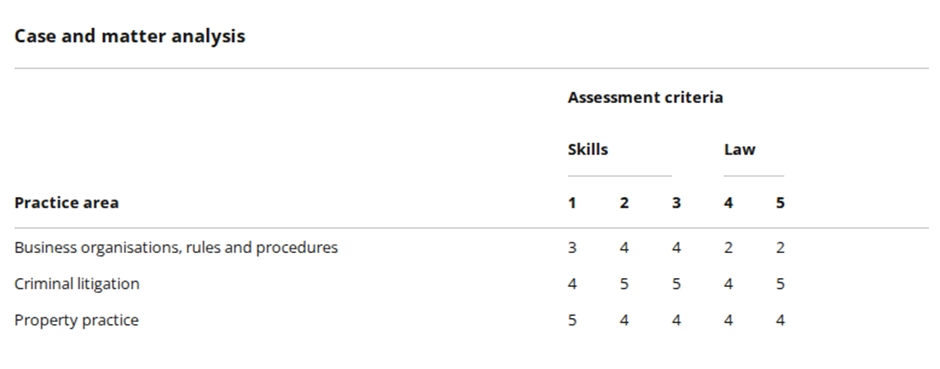
The SQE2’s Marking and Standard Setting Policy is complicated, but in the simplest terms, the assessor will score candidates between 0 and 5 for various skills and their correct and thorough application of the law. In contrast to the objective nature of the SQE1’s marking, SQE2 is graded via the subjective professional judgement of the assessor. There are limited grounds to appeal one’s marks.

On results day, candidates will be provided with a full breakdown of their marks across each of the sixteen stations, and results will be broken down into charts that look like this:

The full list of skills criteria relating to each station can be found here. Examples of skills that candidates will be assessed against include:

  • Listening to the client and using questioning effectively to enable the client to tell the solicitor what is important to them
  • Providing client-focused advice (i.e advice which demonstrates an understanding of the problem from the client’s point of view and what the client wants to achieve, not just from a legal perspective)
  • Using appropriate language and behaviour
  • Presenting a persuasive argument
  • Identifying and use relevant sources and information
  • Structuring the document appropriately and logically

It is possible to score marks for skills whilst not applying the law correctly, and likewise, it’s theoretically possible to score marks for one’s correct application of the law whilst not doing well on skills.  This might provide some comfort to candidates as it means that drawing a blank on the law may not be fatal, but it is naturally more difficult to gain skills marks without having some confidence in the underlying law.

Preparing for SQE2

If you are currently working in a legal role then you’re most likely already developing some of the skills required to pass SQE2. However, in my view it is essential to enrol onto a course with proper training materials and good mock exams in order to pass SQE2.

As with SQE1, preparing for SQE2 will require time, consistency, and dedication. Juggling SQE2 preparation with a full-time job and any other responsibilities will be a challenge for most people.

I sat SQE2 nearly three years after SQE1. This meant a lot of my initial focus for SQE2 was re-learning and memorising the vast curriculum of ‘black letter law’ that was tested in SQE1. I know some candidates sit SQE2 very soon after passing SQE1, and in hindsight this approach has clear advantages, as the underlying law should be ‘fresher’ meaning efforts can focus on honing skills and learning the format of the stations.

A lot has been made of the difficulty and low pass-rate of SQE1, but the SQE2 is also a very tough exam. The SQE2’s pass rate is significantly higher than SQE1 (which, again, should provide some comfort) but SQE2 is still a demanding test of memory and skills under intense time pressure, and it requires significant preparation.

SQE2 is a completely closed-book exam, meaning (unlike solicitors!) you will have to advise your client without being able to check the law. In SQE1, you pick the correct answer from a list, while in SQE2, the right answer is not placed in front of you. I may be in the minority, but I personally found SQE2 to be more challenging than SQE1.

Tips for success

  1. Leverage social networks to learn from other peoples’ experiences. While social media posts about the SQE often relate to the stress and anxiety of the experience, there is also a lot of useful insight out there. If you can block out the negativity, I found reddit to be a great source of SQE information.
  2. Be familiar with the skills being assessed and the marking criteria of each station. The SQE2 marking system can seem labyrinthian, but if you understand what the assessor is grading you on, you can focus your efforts in the right places.
  3. Start preparation early. Create a study plan and stick to it. Don’t expect to have much of a social life until it’s over – celebrate afterwards!
  4. Mocks, mocks, mocks. As with SQE1, it’s crucial to know what to expect on the day, and to be comfortable with the format and layout of the different stations.
  5. Be confident, not complacent. If you’re sitting SQE2, you’ve most likely got through SQE1, and statistically, that’s the hardest part. But don’t rest on your laurels, because SQE2 represents a different type of challenge.

Passing SQE2 and qualification

After confirmation of passing SQE2, and registering two years’ qualifying work experience, all that typically remains before being admitted to the roll of solicitors is to pass the SRA’s character and suitability requirements.

I was able to complete this process within days of receiving my results, and before I knew it I was starting my new role in TV Edwards’ fantastic social welfare team as a qualified solicitor.

Disclaimer: The information on the TV Edwards website is for general information only and reflects the position at the date of publication.