
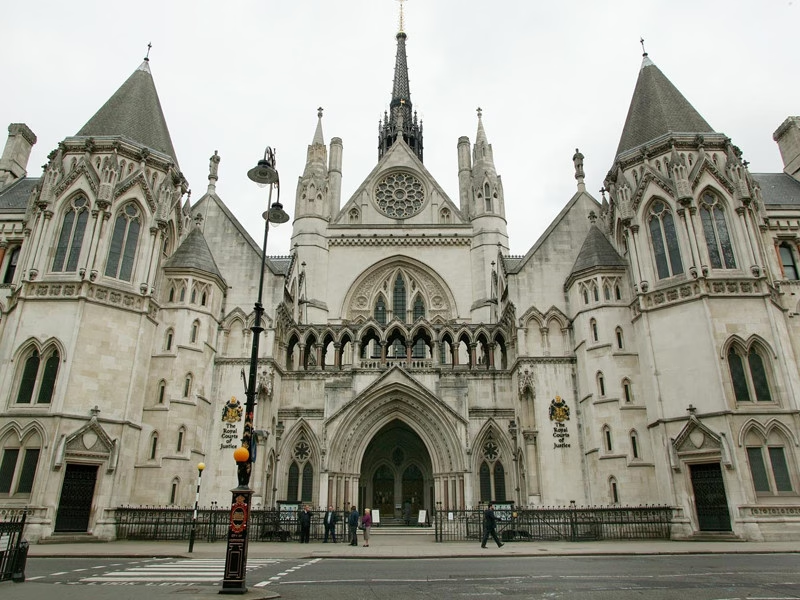


Court of Appeal decides when capacity assessments are needed under the Care Act
The Court of Appeal has handed down a landmark judgment in R (TDB) v London Borough of Haringey [2026] EWCA Civ 1184, providing important guidance on the relationship between the Care Act 2014 and the Mental Capacity Act 2005. The Court unanimously allowed the appeal and quashed the local authority’s Care Act assessment.
TV Edwards acted for TDB, a young adult with autism and complex support needs. The case raised an issue of wider public importance: can a local authority complete a Care Act needs assessment where there are concerns about a person’s decision-making ability without first assessing their mental capacity?
The Court’s answer was clear: where there is reason to doubt a person’s capacity in relation to matters relevant to their care and support needs, an assessment under the Mental Capacity Act must be carried out before the Care Act assessment is completed.
Why the judgment matters
This decision is likely to have significant implications for local authorities, social workers, disabled people and their families.
The Court held that understanding a person’s capacity is often fundamental to understanding their needs, their wellbeing and the support required to keep them safe and enable them to participate fully in decisions about their lives. Capacity cannot be treated as an afterthought where there are genuine concerns about a person’s ability to make relevant decisions.
Importantly, the Court confirmed that:
- A relatively low threshold applies. If there is reason to doubt a person’s capacity in relation to a relevant issue, a capacity assessment should take place.
- The legal presumption of capacity, contained in the Mental Capacity Act, cannot be relied upon as a reason to avoid assessing capacity where concerns have arisen.
- Capacity is decision-specific and must be assessed in relation to the particular decisions that need to be made.
- Whether someone has a learning disability diagnosis is not determinative of whether they may lack capacity.
Specialist expertise as part of a Care Act assessment
The Court also found that, given the complexity of TDB’s needs, the local authority should have sought specialist psychological or psychiatric input as part of the assessment process. It confirmed that local authorities must ensure assessments are carried out by professionals with the appropriate skills, knowledge and expertise and must obtain specialist input where required.
Wider impact
The judgment goes beyond the circumstances of the individual involved. It provides clear guidance for future Care Act assessments and strengthens safeguards for disabled people including those with neurodevelopmental conditions, mental health conditions or cognitive impairments, which affect their ability to participate in decisions about their care.
The Court of Appeal recognised that a proper assessment of capacity can lead to a more accurate understanding of a person’s needs and ultimately better care planning and outcomes for the person being assessed.
Comment
Monica Kreel, lead solicitor in this case, for TDB at TV Edwards, said:
“This is an extremely important judgment for disabled people and others with complex needs. The Court of Appeal has made clear that when there is a reason to question a person’s decision-making ability, local authorities cannot simply proceed on assumptions. Capacity must be properly considered and assessed.
Too often, people with autism, learning difficulties, mental health conditions or other cognitive impairments struggle to access the support they need because their needs have not been fully explored or understood. This judgment reinforces the principle that assessments must be person-centred, informed by the right expertise and grounded in a proper understanding of an individual’s capacity. This will help to ensure disabled people’s autonomy but also provide better safeguarding where necessary. We hope this decision will lead to better assessments, better decision-making and, most importantly, better outcomes for disabled people”
TV Edwards acted for the Appellant, represented by Counsel, Victoria Butler-Cole KC, Gráinne Mellon and Isaac Ricca-Richardson. Mind intervened in the appeal because of the wider importance of the issues raised.