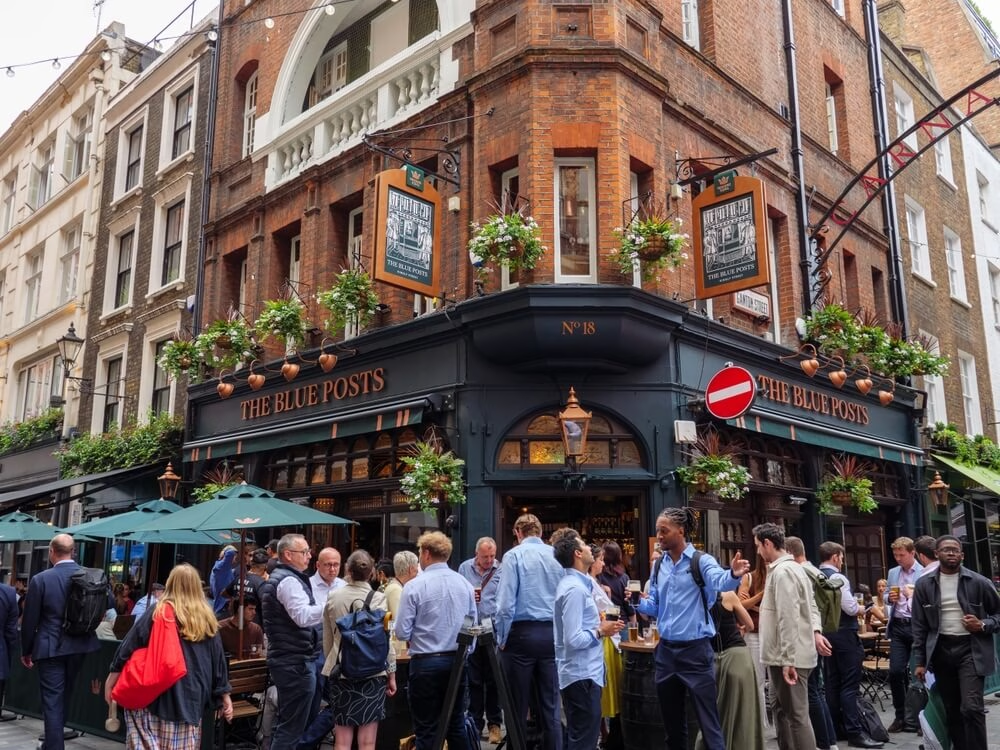

Westminster Council is planning to implement a proposal in its draft Statement of Licensing Policy to discourage people from enjoying alcoholic drinks while standing up in bars and pubs – known as “vertical drinking,” in a bid to reduce excessive drinking and public nuisance. Concerns have been expressed regarding the impact of this recommendation on the social aspect of British pub culture and the late night economy in Soho which is a multi-billion-pound industry.
Westminster Council’s New Policy Proposals
Local authorities are required to prepare and publish a document called a Statement of Licensing Policy which outlines the local principles and framework they apply when making decisions on alcohol, entertainment, and late-night refreshment licenses. The policy must be updated every 5 years in accordance with section 5 of the Licensing Act 2003.
In June 2026, Westminster Council published draft proposals for its fresh Statement of Licensing Policy which is due to take effect in October 2026. In the draft proposals, the council stated that its aim was to “discourage excessive drunkenness and encourage the provision of more seating in premises that serve alcohol for people to sit and enjoy a drink and order food by table service in place of open bar space that caters for high volume vertical drinking.” The guidance suggests that applicants who are planning to open new bars or restaurants in Westminster and require licences should implement the restrictions by applying for “a predominantly seated operation with fixed seating,” alongside waiter service replacing vertical drinking and restrictions on customers consuming alcohol while standing.
The council also operates a policy to refuse new licences for restaurants, pubs, bars, fast food or music venue licences in the Soho and West End areas, which are regarded as a cumulative impact zone due to the high density and volume of licensed venues. This results in an increased risk of crime and disorder and public nuisance. The new draft policy states, “The introduction of measures to reduce the extent of, or to remove opportunities for, vertical drinking could address the underlying reasons for the [cumulative impact] policy.”
Westminster Council has confirmed that the new policy proposals do not intend to ban drinking while standing up in pubs in Soho and instead intend to encourage venues to manage their customers to prevent overcrowding on pavements and excessive drinking. The leader of Westminster City Council has clarified that the proposals are about “public safety” and “There is no plan, and never has been, to ban drinking while standing up in a Westminster pub.”
Westminster has the UK’s largest concentration of licensed premises and the largest evening and nightlife economy, with about 500 pubs, bars and wine bars, and roughly 1,750 cafes and restaurants. Therefore, it contributes massively to the country’s nighttime economy and aids tourism and employment, with businesses of the area generating around £5 billion per year and employing around 8,000 people.
The Reaction to the Proposals
London’s Mayor, Sadiq Khan, opposes the proposals put forward by Westminster Council in its new policy, due to the negative impact they could have on the economy. The Mayor’s new strategic licensing regime, which came into force on 26 June 2026 through the English Devolution and Community Empowerment Act 2026, grants him powers to intervene in local alcohol, entertainment, and late-night refreshment licensing matters across the capital’s 32 boroughs. If Westminster’s new policy is approved, it would apply to Soho and the West End – two of the capital city’s largest nightlife hubs. However, the Mayor is using his new licensing powers for the first time to ask Westminster Council to rewrite the draft policy. The new London-wide strategic licensing framework allows him to create a city-wide policy via secondary legislation and affords him more authority on licensing decisions.
The Mayor is opposing “restrictive and anti-growth policies” in favour of protecting London’s vital nightlife and hospitality industries. A spokesperson for the Mayor’s office has stated, “At a time when nightlife and hospitality needs our support more than ever, policies like these would leave our venues facing extinction. And it would make our capital city less attractive for tourists.” The Mayor is also calling to get rid of the “core hours” policy to allow venues to stay open late into the night, stating policies that expect pubs, restaurants and nightclubs to close by 11:30pm on weekdays and midnight at weekends, are “overly onerous and archaic.”
Significantly, the Prime Minister’s office also opposes Westminster Council’s new policy proposals. A spokesperson for 10 Downing Street stated, “Busy pubs full of people talking to each other is not a public nuisance, it is British life and it is thousands of jobs” and “the Prime Minister encourages local leaders to work with the industry so that pubs can continue to thrive.”
Additionally, the proposals have been criticised by the Soho Business Alliance, a non-profit organisation which represents business owners in Soho to protect the area’s economic diversity, heritage, and unique night-time culture. A spokesperson for the organisation has stated that the council is “trying to change the nature of Soho and it’s quite sad that they’ve gone to such lengths to sanitise the area.”
The chief executive of the Night Time Industries Association in London has also expressed concerns, stating, “Standing in pubs has always been part of Britain’s pub culture. It’s how people meet friends, watch live sport, wait to be served and enjoy the unique atmosphere that pubs have provided for generations.” They also stated, “Encouraging policies that favour more seating and reduced standing space risks changing the very character of these venues while reducing capacity, increasing operating costs and limiting flexibility for responsible businesses already under significant financial pressure.” Thus, being able to stand up while drinking in pubs is widely regarded as part of Britain’s pub culture and allows for socialising. There is clear concern about the impact of the proposals on businesses in the hospitality industry.
The Impact on the Pub Industry
The owner of a famous historic pub in Soho called The French House, has expressed that Westminster Council’s new policy proposals would lead to closures, redundancies, and loss of business. They are aware that their customers enjoy having a drink while standing up and being able to dance and move around when they go out.
The general manager of Bradley’s Spanish Bar, another pub in Soho, stated reducing “vertical drinking” would be the “nail in the coffin,” especially for independent pubs. He mentioned that his venue has limited seating and it would not be viable to operate the business with the restrictions imposed.
In recent years, a number of pubs have closed due to rising costs and taxes and shifting consumer habits. According to the British Beer and Pub Association (BBPA), 161 pubs closed in the first three months of 2026 across England, Scotland and Wales, equating to the loss of around 2,400 jobs. To put this into perspective, there were 44,650 pubs nationwide in the year 2025, compared with 60,800 in the year 2000. In addition to the impact on opportunities to socialise, there is also concern that the proposed policy restrictions could lead to additional business closures.
Although it is still possible to enjoy a seated drink with friends or loved ones, being able to stand up outside a pub offers a different experience and the chance to move around and speak freely with different people nearby.
City Hall, the official headquarters and office for the Mayor, has stated, “At a time when venues need our support more than ever, the rules on licensing are stacked against them. That’s why the new powers the Mayor is getting from government are so important, as they mean the Mayor will be able to call in licensing decisions and have a say in local policies to protect London’s vital nightlife and hospitality industries.”
How Our Licensing Solicitors Can Help
We provide comprehensive advice and representation on all aspects of licensing policies and licence applications:
We can help you by:
- Reviewing and interpreting local authority licensing policies
- Advising on how policies affect your application
- Preparing compliant and strategically structured licence applications
- Representing you in licensing hearings and negotiations
- Justifying applications that deviate from licensing policies
- Helping protect your licence from review or revocation
We act for a wide range of businesses, including restaurants, bars, pubs, nightclubs, event venues, and hospitality operators. Our solicitors routinely deal with applications for venues in cumulative impact zones, and we have experience with Westminster Council and other local authorities across London, making us equipped to advise any premises experiencing difficulties with a licensing authority.
We are specialists in negotiating with responsible authorities, residents’ associations and neighbouring properties to seek a compromise and ensure a suitable licence is obtained.
Why Choose TV Edwards?
- Highly ranked in legal directories – Legal 500 and Chambers UK
- Immediate emergency support – Call us on 0203 440 8000
- Specialist representation
- Hardworking problem-solvers – We fearlessly challenge evidence, protecting your interests
- Honest and down-to-earth – We explain your options compassionately and in plain English