If you have been injured in a supermarket, a shop or another business open to the public, you may be entitled to claim compensation.
Businesses that invite the public onto their premises have a legal responsibility to take reasonable steps to keep visitors safe. Where they fail to do so and someone is hurt as a result, a claim may follow.
Many people hesitate before making a claim of this kind, particularly against a large retailer. You should not feel that way. Our specialist solicitors will look at what happened, tell you honestly whether we think you have a case, and explain what pursuing it would involve. We act for clients across London and the wider UK as part of our wider team of personal injury solicitors in London.
Injured in a Supermarket or Shop? Contact Us Today
Evidence in these cases can disappear quickly. CCTV footage is often kept for a short period only, and accident records can be difficult to obtain once time has passed. Getting advice early gives your claim the best chance.
Our occupiers’ liability solicitors can help you to:
- Understand whether you are likely to have a valid claim
- Secure CCTV footage and accident records before they are lost
- Establish who was responsible for the premises
- Obtain medical evidence and assess the value of your claim
- Deal with the retailer and its insurers on your behalf
Speak to our team today to discuss your circumstances.
What Is an Occupiers’ Liability Claim?
An occupiers’ liability claim is a compensation claim brought by someone who has been injured because of the condition of premises they were lawfully visiting.
The responsibility rests with the occupier — the person or organisation in control of the premises. That is not always the owner. In a shopping centre, for example, the individual retailer may be responsible for its own store while the centre’s management company is responsible for shared walkways.
The duty owed to lawful visitors is set out in the Occupiers’ Liability Act 1957. In broad terms, the occupier must take such care as is reasonable in the circumstances to make sure visitors are reasonably safe while using the premises for the purpose they were invited there for.
The important word is reasonable. A supermarket is not automatically liable simply because someone was injured on its premises. The question is whether it took reasonable steps to identify and deal with the hazard.
Common Supermarket and Shop Accidents
We advise on claims arising from a wide range of incidents in retail premises, including:
- Slips on spillages, wet floors or recently cleaned surfaces
- Falls caused by trailing cables, uneven flooring or damaged mats
- Injuries from stock falling from shelves or badly stacked displays
- Trips over boxes, pallets, cages or cleaning equipment left in aisles
- Accidents involving trolleys, automatic doors or lifts
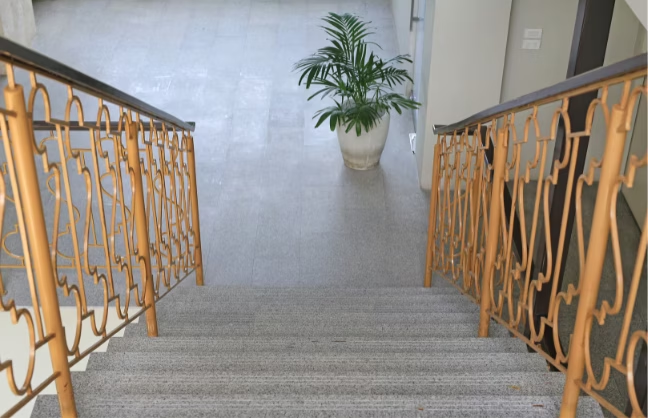
- Falls on poorly maintained or badly lit stairs
- Injuries in car parks and loading areas attached to the premises
- If your accident is not listed here, that does not mean you have no claim. The principles are the same whatever the hazard.
When Is a Supermarket or Shop Responsible?
Establishing responsibility is the heart of these cases, and it is where an experienced solicitor makes the most difference.
Cleaning and Inspection Systems
Retailers know that spillages happen. What matters is whether the business had a reasonable system in place to find and deal with hazards, and whether that system was actually being followed on the day.
In practice, this usually turns on questions such as how often the area was inspected, whether those inspections were recorded, how long the hazard had been there before you fell, and whether warning signs were in place.
Retailers and their insurers will often say the spillage had only just occurred and could not reasonably have been found in time. Evidence such as CCTV footage, cleaning records and witness accounts is frequently what determines whether that argument stands up.
Where Responsibility Is Shared
Sometimes more than one organisation is involved — a retailer and a contract cleaning company, for example, or a store and a shopping centre operator. It is also possible for a claim to succeed even where the injured person was partly at fault, with any compensation reduced to reflect that.
We will identify the correct party or parties to claim against and advise you honestly about any weaknesses in your case.
What to Do After an Accident in a Shop
If you have been injured recently, the following steps will help protect your position:
- Report it to a member of staff and ask for the accident to be recorded in the accident book. Ask for a copy or a reference.
- Take photographs of the hazard, the surrounding area and any warning signs — or the absence of them — before anything is cleaned up.
- Note the time and exact location, including the aisle or department.
- Take the names and contact details of anyone who saw what happened.
- Keep your receipt or any other proof that you were on the premises.
- Seek medical attention, even if the injury seems minor at first. Medical records are important evidence.
- Keep a record of your expenses, including travel, treatment and time off work.
If you did not manage to do all of this, please still speak to us. Claims frequently succeed without a complete record, and we can request CCTV footage and accident reports on your behalf.
What Supermarket Accident Compensation Can Cover
Every claim is different, and the amount depends on the injury and its effect on your life. Broadly, compensation falls into two parts.
The first covers the injury itself — the pain, suffering and loss of enjoyment of life it has caused. This is assessed with the benefit of independent medical evidence.
The second covers your financial losses, which may include:
- Loss of earnings, including future losses where you cannot return to the same work
- Medical treatment, physiotherapy and prescription costs
- Travel to appointments
- Care and assistance provided by family members
- Adaptations or equipment needed as a result of the injury
We will assess your claim properly and explain clearly how the figure has been reached.
Accidents on Other Types of Premises
The same principles apply well beyond supermarkets. We advise on claims arising from accidents in restaurants, pubs, hotels, gyms, cinemas, car parks and other commercial premises open to the public.
Where an accident happened somewhere other than business premises, a different page may be more useful to you. If you were injured in a public place such as a park or leisure facility, see our page on public liability claims. If you tripped or fell on a pavement or footpath, see slip and trip claims. If you were injured while working on someone else’s premises, your employer’s duties are also relevant, and our page on accident at work claims explains more.
Related Personal Injury Services
How Our Occupiers’ Liability Solicitors Can Help
Claims against large retailers are usually defended by experienced insurers. Having a solicitor who understands how these cases are argued puts you on an even footing.
We can:
- Assess your case honestly and tell you whether we think it is worth pursuing
- Act quickly to secure CCTV footage, accident reports and cleaning records
- Identify the correct organisation or organisations to claim against
- Obtain independent medical evidence about your injury and recovery
- Calculate your losses in full, including future losses where relevant
- Negotiate with the retailer’s insurers on your behalf
- Issue court proceedings where a fair settlement cannot be reached
- Keep you updated in plain English throughout
Where it is easier for you, we can meet at your home or in hospital, and we can arrange an independent interpreter if English is not your first language.
Why Choose TV Edwards?
- Experienced personal injury solicitors. Your case is handled by a named solicitor who knows how retailers and their insurers defend these claims.
- Honest advice from the outset. If we do not think a claim is likely to succeed, we will tell you, rather than encouraging you to pursue it.
- Fast action on evidence. We know how quickly CCTV footage is overwritten and we prioritise securing it.
- An established London firm. We have supported clients across London and the wider UK for many years.
- Clear communication. You will always know what stage your claim has reached and what happens next.
- Practical support. Home and hospital visits and independent interpreters are available where they would help.
Client Testimonials
Contact Our Solicitors Today
Supermarket and Shop Accident FAQs
Can I claim if I slipped in a supermarket?
Possibly. It depends on whether the supermarket took reasonable steps to prevent the accident. The key questions are usually how long the hazard had been there, whether the store had a proper system for inspecting and cleaning the area, whether that system was followed, and whether any warning was given. If a spillage had been on the floor for some time without anyone noticing, a claim is likely to be stronger. We can assess this for you.
How long do I have to make a claim?
In most cases you have three years from the date of the accident to start a claim. Different rules apply to children and to people who lack the mental capacity to bring a claim themselves. Even within the three-year period, it is far better to seek advice early, because CCTV footage and accident records are often only kept for a limited time.
What if I did not report the accident at the time?
You can still claim. Reporting the accident at the time is helpful, but it is not a legal requirement and many people are too shaken or in too much pain to think of it. Other evidence — medical records, receipts, photographs, witnesses, CCTV — can establish what happened. Contact us as soon as you can so we can request the relevant records.
Will I have to go to court?
Most claims of this kind are settled without a court hearing. Court proceedings are sometimes issued as part of the process, often to protect the time limit or to apply pressure where an insurer is being unreasonable, but that does not necessarily mean you will have to give evidence at a trial. We will explain what is happening at every stage and you will never be committed to a step without understanding it first.