nesar, Author at TV EDWARDS - Page 19 of 30
TV EDWARDS SOLICITORS LLP

Buying a Property

Our Services Contact Us
TV Edwards Blog

What you need to know about buying a property

Buying a property can feel daunting and stressful at times. This is why, at TV Edwards, we make the process as smooth as possible so you don’t have to worry about the legal side. Buying a property is one of your most important purchases and it is important to pick a Solicitor who will look after your interests but who you also feel comfortable with.

“You have been really kind and helpful from the day I met you. I wish all other solicitors behave and act like you, not just driven by fees. My pleasure to be your client.”

There are numerous different ways of buying a property:

  • You might have found a freehold house or a leasehold flat.
  • The property might be a new build, or you may be starting out with a shared ownership property.
  • Where you are purchasing a flat with a long lease, there could be a Management Company or you could also receive a share of the freehold.

Each transaction will have its own particular aspects and considerations. Whatever the transaction, we have a range of specialist Solicitors who can assist.

There are also numerous ways of financing your property purchase

Whether it’s a standard mortgage, a gift or loan from a friend or relative, your own savings or some combination, we will sensitively guide you through what you need to provide to evidence the available funds.

We act for a full range of clients from first time buyers to experienced property investors and we tailor our service to our individual client, based on your needs and expectations.

There are numerous legal steps involved in buying a property which can feel overwhelming.

As soon as you instruct us, we take care of everything on your behalf, communicating with the Seller’s Solicitor, the Estate Agents and your mortgage broker to make sure that we work with everyone to progress the purchase as efficiently as possible. We take care of your mortgage, paying your stamp duty land tax and any other matters which crop up. We talk you through the steps involved at each stage, so you know exactly where we are in the process and what the next steps are.

Sometimes, issues do come up.

We carry out a thorough investigation of title so that you are fully aware of any potential issues with the property you are purchasing before the purchase goes through. We talk through and explain any issues with you and advise you on how they should be dealt with. We are proactive and come up with solutions to enable you to progress. We are experienced in all aspects of property law, not just conveyancing so can assist with any other required ancillary matters such as Declarations of Trust and Lease Extensions.

So, why us?

We are friendly, experienced Solicitors who care about your purchase.

With up-to-date expert knowledge of property law, we build relationships with our clients throughout their transactions and as a result, many of our clients are repeat clients or referrals from family/ friends.

We take on a select number of cases so that we can be fully attentive to all our clients. We think this is a winning combination, demonstrated by some of our feedback below:

“Thank so much for all your assistance with this – it would have been even more difficult without your help and advice. It was so reassuring to know that you were dealing with everything and were always available.”

“I have very much appreciated your quick and precise views given with every step all through.”

“We could not have asked for a more professional, astute, thorough and personable relationship.”

If you want to learn more or obtain a quote for our services, please contact Juanita Francis, Head of Property, at juanita.francis@tvedwards.com or call 0203 440 8000.

TV EDWARDS SOLICITORS LLP

Moving towards an Extended Lease

Our Services Contact Us
TV Edwards Blog

Moving Towards an Extended Lease

Leasehold property owners commonly decide to extend the term of their lease. Residential property owners seeking to replace their existing lease with a longer term often pursue an extended lease, which can also be used to modify some other terms of what may be a very old document. Financially, it provides greater security for lenders and can help arrange finance on more favourable terms.

Leasehold Reform, Housing and Urban Developments Act 1993

The right to seek a new lease is sometimes arranged voluntarily with your landlord. When it is done this way, it can be on whatever terms the parties mutually agree to. Where you are not able to agree terms, a leaseholder can instead follow the statutory process for extending your lease instead. Under this procedure, a landlord can be forced to:

  • Extend the lease by 90 years (plus the remainder of the term under the existing lease)
  • Reduce the rent to being ‘a peppercorn rent’
  • Take into account certain other minor modifications

What is involved in the process of an extended lease?

The process starts through the service known as a Section 42 Notice and begins a timescale and obligation to adhere to certain procedures (both by the freeholder and the leaseholder). In order to qualify for this procedure, a leaseholder needs to own the property for at least two years. It must pertain to a ‘flat’ and the property must be subject to a long lease.

Once the statutory process begins, the parties have certain rights and obligations to adhere to.

These rights and obligations include responding within certain timeframes, payment of a statutory deposit (usually 10% of the proposed premium) and negotiating to reach an agreement on the new lease’s terms of acquisition. If this agreement is not possible, the parties can refer the matter to the First Tier Tribunal to have the terms of acquisitions determined; thereby resolving any impasse.

Lease extensions involve a few different parties working together including surveyors/valuers, the freeholder and leaseholders. Some problems can occur when either a freehold cannot be located or if one party does not respond as required under the statutory process. In such situations, the parties can also seek assistance from the Court in applying for a vesting order or otherwise seeking an order of the court for a party to comply with their obligations pursuant to a statutory notice.

When to consider extending your lease

It is particularly important to consider extending your lease if you are approaching 80 years or less remaining. When there are 80 years or less remaining on your lease, a freeholder can seek an additional premium payable as part of the lease extension process (known as Marriage Value). This additional sum, to compensate the freeholder for the loss of reasonable expectation of recovering the property at the end of your lease, can sometimes be a very hefty additional (and avoidable) payment.

Leasehold Reform

Lease extensions (sometimes referred to as lease enfranchisements) have been the subject of a government commission as an area to be reformed. On 19 July 2018, the Law Commission published proposed measures as to how the government could help homeowners buy the freehold of their homes. The proposals focused on removing technical barriers and complex rules, enhancing rights of leasehold owners on estates and improving and simplifying the process.

The changes to leasehold reform are still under governmental review and as such are open to change. Our Property Dispute Solicitors are keeping an eye on developments in this area to ensure we continue to meet the needs of our current and future clients.

What to do next

Whether you seek to extend your lease or you are a freeholder and have had someone serve a notice of lease extension on you, our solicitors with property litigation experience in our Dispute Resolution Department can help you understand the situation you are in. We explain your available options and provide friendly and thorough advice to help you make informed decisions. Once the contentious element of a lease extension process is completed, our solicitors within our Residential Conveyancing Department can also help you move forward from terms of acquisition to completion of the new lease, helping you finalising your property investment in a way that works for you.

TV EDWARDS SOLICITORS LLP

Disclosure

Our Services Contact Us
TV Edwards Blog

Disclosure is a key phase in litigation. Litigation in England and Wales is carried out ‘cards face up on the table’. Whether you are the Claimant or Defendant you are obliged to provide documents which either support or adversely affect your case.

Importance of disclosure

If you are commencing litigation it is likely any claim you make will rely on certain documents to advance your claim. A list of these documents will be given to your opponent at the disclosure stage of litigation.

If you do not disclose your supporting documents at the disclosure stage you may be unable to rely on them at trial and this may well hinder any chance of success.

Not only are you obliged to provide documents that you rely on but also which adversely affect your case or support another party’s case. If a person makes or cause to be made a false disclosure statement without an honest belief in its truth proceedings for contempt of court may be brought against them.

There can also be financial consequences for a party who does not comply with disclosure requirements. In Earles v Barclays Bank Plc the Court ruled that the Defendant who was successful in Defending the claim should only be allowed to recover half of its costs because it failed to conduct disclosure properly.

Also where a party does not disclose a document that harms their case they may find their case struck out if they fail to comply with an order for specific disclosure.

What is a document

The meaning of the word ‘document’ is interpreted very widely by the court in the context of disclosure. A ‘document’ is anything in which information of any description is recorded. ‘Documents’ therefore include written documents, audio recordings, videos and photographs. It also includes electronic documents such as e-mails, word-processed documents and databases.

Accordingly, you may have to provide your solicitor with a vast amount of documents. Our solicitors ensure that the relevant documents are identified at an early stage so that you the necessary time to gather and provide the documents.

Conclusion

Disclosure is an important part of litigation and it is imperative that the relevant documents are identified by your solicitor at the outset of a matter. Failure to disclose key documents can be terminal to your case.

The above only touches on a few aspects of disclosure as it can be a complex and time-consuming phase of litigation. At TV Edwards our dispute resolution solicitors are well versed to deal with all aspects of litigation and alternative dispute resolution. If you would like to find out about our services more generally, please contact our Dispute Resolution team at TV Edwards Solicitors LLP.

TV EDWARDS SOLICITORS LLP

Who should pay the costs of the contact centre where there have been findings of domestic abuse against the person seeking contact?

Our Services Contact Us
TV Edwards Blog

The High Court considered this recently in the case of Griffiths v Griffiths (Guidance on Contact Costs) [2022] EWHC 113 (Fam). This was a case where the father, who has recently been identified following the decision of the Court of Appeal in Griffiths v Tickle and others [2021] EWCA Civ 1882, as Andrew Griffiths, a former conservative MP, submitted an application to the Family Court in Derby in June 2019 for a child arrangements order, seeking direct contact with the parties’ child. The mother, Kate Griffiths MP, opposed the application and raised very serious allegations of domestic abuse against the father. An order was made in July 2019 for the father to have supervised contact in a contact centre once a week and he was ordered to cover the costs of this in full. Some eight months later, contact was suspended in March 2020 due to the Covid-19 pandemic, and the father’s contact was changed to indirect video contact. Shortly after this, the father applied for the costs of the contact centre to be met in full by the mother, once the contact centre reopened, as he was unemployed at the time, and the mother had recently been appointed as an MP. An order was made in May 2020, amending the July 2019 order so that the costs of the contact centre were to be shared equally between the mother and father. Direct contact was then reinstated in September 2020 when the contact centres opened again.

A fact-finding hearing took place in November 2020 and findings were found about the father’s behaviour towards the mother which included rape and sexual abuse, a pattern of him controlling and behaving coercively towards her and her being physically and verbally abused by him. There were also findings that the father physically abused a relative. The father did not appeal any of these findings. Despite these findings being made, and the mother subsequently applying to suspend the father’s direct contact pending the outcome of a psychological assessment of him, the Judge ordered at a hearing in June 2021 that direct supervised contact should resume once the centre manager had completed a risk assessment of the father and that payment of the contact centre fees would remain as mentioned above, i.e. split equally between the parties.

The mother applied for permission to appeal this order on the following 4 grounds:
Ground 1: the Judge was wrong to order that the mother, a victim of rape, share the costs of supervised contact with her rapist, the father. This was wrong in principle, against public policy and breached the mother’s and the child’s Articles 8 and 14 rights. It is wrong in law for the family courts to interpret widely section 11(7) of the Children Act 1989 to the extent that a party is directed to pay for the costs of contact.
Overlapping with Ground 1 was Ground 2: the law as presently interpreted by the family courts in permitting a rape victim to be ordered to pay a rapist’s contact costs was in breach of the mother’s Articles 8 and 14 Convention rights.

Ground 3: the Judge was wrong to order direct contact and did not apply paragraph 36 of Practice Direction 12J, in failing to consider the short, medium, and long-term harm of contact on the mother and the child and the judge failed to consider at all the father’s capacity to appreciate the effect of past domestic abuse as per paragraph 37(e) of PD12J.

Ground 4: the Judge was wrong in failing to apply paragraph 40 of PD 12J and to explain by way of reference to the welfare checklist and the factors in paragraphs 36 and 37 or otherwise why she took the view that domestic abuse having been proven, contact with the perpetrator would not expose the child to the risk of harm and was beneficial for the child.

Mrs Justice Lieven granted the mother permission to appeal the order but refused to discharge the child arrangements order pending appeal. The appeal was heard before Mrs Justice Arbuthnot (Arbuthnot J) who identified three questions relevant to the appeal:-

  1. Whether, in principle, a court has the power to order that a party pay for contact under s11(7) of the Children Act 1989;
  2. Whether the Judge was wrong to order direct contact in the particular circumstances of this case; and
  3. Whether a victim of abuse should pay the costs of contact for the abuser to have contact with the parties’ child.
    Firstly, Arbuthnot J rejected the mother’s argument that there was no power to order a party to pay the costs of contact, explaining that it is clear from section 11(7) Children Act 1989 that this section was intended for the court to have a wide discretion to enable it to give directions the court feels appropriate in respect of the costs of contact centres.
    Arbuthnot J considered that the Judge who ordered the direct contact in June 2021 did not allow herself sufficient time to determine the issue of interim contact, which was disputed by the parties, but the hearing was only listed for one hour. She determined that the hearing should have been adjourned to another day with a longer listing to allow for proper consideration of the relevant considerations arising from the application of PD12J. In particular the emotional safety of the mother, before ordering the resumption of direct contact and how the findings she had made at the fact-finding hearing influenced her decision on contact. Arbuthnot J accepted that the father had a long-standing relationship with the child via both indirect and direct contact, but given the findings made, and the failure to consider PD12J appropriately, direct contact should not have been ordered at the June 2021 hearing.
    The Judge then went on to explain that although she could not envisage a situation where a court would order the victim to share the costs of contact, she was wary of giving guidance that is “too narrow” to be applied in other extraordinary cases in the family courts. She provided guidance for the costs of contact in relation to cases where abuse has been found or admitted which is set out below:-
    • First, there must be a very strong presumption against a victim of domestic abuse paying for the contact of their child with the abuser; and

• Second, if, wholly exceptionally, the court has to consider this, the matters a court might want to take into account could include the following:
a. The welfare checklist including the age of the child
b. The factors in PD12J (set out in the judgment)
c. The nature of the abuse proved or admitted, and the parties’ conduct that the court considers relevant
d. The impact of the abuse on the caregiver with consideration as to whether any payment would give rise to financial control
e. The extent of the relationship between the child and the abusive party
f. The nature of the section 8 order made
g. The parties’ financial resources
h. The cost of the contact
i. Whether, if the contact is in the best interests of the child, it would take place without a sharing of the costs.
Arbuthnot J set aside (declared invalid) the previous order for direct contact and held that this would need to be considered further once a psychological report of the father had been obtained and that relevant consideration would need to be given to PD12J. The mother was not ordered to contribute anything towards the costs of the contact centre. The Judge held that if contact is directed in the future, then the guidance as set out above would need to be applied.


The Judgment can be found here https://www.bailii.org/ew/cases/EWHC/Fam/2022/113.html

Separately, following applications by journalists, Louise Tickle and Brian Farmer, the High Court granted permission for the fact-finding hearing to be published with the names of the father and the mother included, given that the parties are public figures. The father appealed this decision, accepting that the judgment could be published, but maintaining that he and the mother should remain anonymised. The Association of Lawyers for Children were granted permission to intervene on appeal and were represented by TV Edwards LLP.

Should you need advice on domestic abuse or child arrangements we have a large expert team which would be happy to assist, we can be contacted on 0203 4408000 or by email A_FamilyReferrals@tvedwards.com

TV EDWARDS SOLICITORS LLP

Shareholder and Partner Disputes: what you need to know

Our Services Contact Us
TV Edwards Blog

Making group decisions has never been an easy or straightforward task. Depending on the number of individuals being looked for a consensus, the importance of the matters being decided and the strength of the opinions held.

To adapt to the realities of modern-day business, may companies and partnerships have adopted themselves in a variety of models for flexibility, informality and ease of day-to-day management. Whether your arrangement is informal or reflected in written documentation the situations you face can also range from the straightforward to the more complex. Our goal is to assist in making sure you position is respected, helping manage your expectations of what is accomplishable and working with you to enact those strategies to fruition. This can be done through a series of mediums ranging negotiations, from round-table discussion, mediation, arbitration to court application. Our lawyers help you assess your competing priorities to help you decide which option is best suited for you.

Squabbles had by Shareholders

A company’s directors have a number of different obligations and duties to perform for the benefit of the shareholders of their company. This is in addition to the rights and obligations shareholders have between themselves and become particularly relevant when one takes issue with the conduct of the other (or more commonly when a minority shareholder disagrees with the actions a majority shareholder or shareholding group may be taking).

Shareholders obligations are contained both within the company’s articles of association and have a basis is statute as well. Navigating these different powers and rights a shareholder has is the first step in trying to determine or otherwise resolve alleged breaches of duties between such actors. Each individual situation is largely fact specific but it is our role in assisting and advising our commercial clients to reach a resolution whether amicably or through court application.

It is not always the case that a minority interest can do nothing in respect of the company they are a member of. Whether you are considering a derivative action (redress against directors), unfair prejudice petition or otherwise seeking to wind-up the company – the advice of our dispute resolution lawyers is beneficial in such circumstances to allow for you to weight the benefits and risks of action to make more informed decisions.

Problems Amongst Partners

Issues often arise when more informal arrangements exist between two or more individuals working as a business. Partnerships, while ordinarily made by way of formal written partnership deed, can exist when more than one individual carries on business in common with a view of profit. Partnerships, just like people, evolve over time and disagreement can occur when partnerships are seeking to expand, remove a partner (whether following poor conduct or otherwise) or change the business scope and nature of the business direction.

While never a straightforward situation, as business disputes often involve a mixture of issues and personal sentiment – such areas are navigated professionally and delicately by the solicitors in our dispute resolution department. We assist both existing and leaving partners in in professional contexts including accountants, actuaries, architects, medical and dental practitioners, legal advisors and surveyors.  We offer advice and assistance in partner removing or expulsion, breaches of financial and partnership duties, dissolving partnerships and actions for an account of profits.

TV EDWARDS SOLICITORS LLP

Legal Test for Leave to Apply to Discharge an SGO

Our Services Contact Us
TV Edwards Blog

In the recent case of Re: M (Special Guardianship Order: Leave to Apply to Discharge) [2021] EWCA Civ 442, the court considered the legal test for leave to apply to discharge an SGO. The Court approved the two-stage approach decided in the established case of Warwickshire, determined that a change in circumstances was necessary but not in itself sufficient and that the Court needed to weigh the welfare of the child with the prospects of success.

This appeal concerned the construction of Section 14(d) of the Children Act 1989 in the context of an appreciation of nature and affect of SGO. The appeal also concerned the circumstances in which an application for a Child Arrangements Order can be summarily dismissed.

Background

The proceedings concerned a boy ‘C’ aged 9 in October 2016. Proceedings were issued due to a breakdown of his mother’s mental health. He moved to live with his maternal grandmother and her partner (“the grandparents”). The mother was assessed by a Consultant Psychiatrist as having an emotionally unstable personality disorder and it was recommended that she required long term therapy, the time frame of which was over 12-18months. At the time of the assessment the mother did not recognise the need for the work to be undertaken. It was agreed that the mother when well was able to parent C to a good enough standard however the concern was that when she was unwell, she could not meet C’s needs. The outcome of the care proceedings was a special guardianship order being made in the grandparents’ favour without opposition. It was accompanied by written agreement which was approved by the Local Authority and the Court. The agreement which described itself as unpinning the SGO spelled out how decisions for the child would be taken and how information would be exchanged. There were also several directions made setting out the contact arrangements so that C could still retain a relationship with his mother.

In February 2020, the mother applied for leave to make an application to discharge the SGO with a view to C returning to her care. She made a further application for contact with C, making an application for a child arrangements order. The mother submitted that her mental health was much improved however her application was opposed by the Grandparents on the basis that it was not in C’s best interests to have a change in carer. The local authority expressed concern about the SGO being revoked and the instability this could cause for the child.

In giving judgement the Court of Appeal considered the law in respect of special guardianship orders, commenting that the purpose of a special guardianship order is to achieve permanence for the child. The objective of planning for permanence is therefore to ensure that children have a secure, stable, and loving family to support them through childhood and beyond and to give them a sense of security, continuity, and commitment, identity and belonging.

In terms of discharge or variation of a Special Guardianship Order, the Court turned to Section 14(d) of the 1989 Act which is concerned with the manner in which Special Guardianship Orders can be varied or discharged. A parent seeking to discharge a Special Guardianship Order requires leave of the court which can only be given if the court is satisfied that there has been a significant change in circumstances. The court looked at what was meant by a ‘significant change in circumstances’ and cited the case of Re: G (Special Guardianship Order) [2010] EWCA Civ 300, in which it was said that when considering an application for leave to discharge an SGO, the Court should follow the two stage approach applicable to applications for leave to revoke a Placement Order set out in M v Warwickshire County Council [2007] EWCA Civ 1084. The first stage of the test is that there must have been a significant change in circumstances. Significant simply means ‘considerable, noteworthy or important’. The second stage is that there must be a real prospect of success. It was concluded that a change in circumstance is likely to be intertwined with the prospects of success, and the greater the prospects of success, the more cogent the welfare arguments must be if leave is to be refused. The court went on to say that the assessment concerns the affect on the child’s welfare of the application to discharge the special guardianship order being heard or not heard, the question of whether it is in the child’s interest for the SGO to be discharged only arises if leave is granted at which welfare is undoubtedly paramount.

The mother in this case had also made an application for contact in respect of C. The judged at first instance not only refused her application for leave to apply to discharge the SGO, she also concluded it was not in C’s best interests for there to be a contact order. The Court of Appeal determined that such applications should not be considered an abuse of process as a matter of principle. A parent has a right to issue an application for Child Arrangements Order (other than a lives with order) and when issued the Court must consider the application on its merits. The court concluded that that the appeal should succeed for several reasons including that the test that the judge applied for change in circumstances was too high as she considered that all of the issues with led to the making of the SGO needed to have been resolved and the judge’s conclusion followed from the test that she applied. The Court of Appeal also considered that the judge had not considered the issue of welfare correctly. The appeal was therefore allowed, and the previous orders were set aside. The mother was granted leave to apply to discharge the SGO and her application for contact was also restored.

Alpa Ghelani is an Associate solicitor in the Family department at TV Edwards. She has broad professional experience in relation to children law and special guardianship cases. Contact Alpa on alpa.ghelani@tvedwards.com or 020 3440 8184 for advice on a related query.

TV EDWARDS SOLICITORS LLP

Social Welfare team highly ranked by Chambers and Partners!

Our Services Contact Us
TV Edwards Blog

We are very pleased that the Social Welfare Team at TV Edwards LLP has retained its ranking in Band 2 of the Social Housing category of the Chambers and Partners Legal Directory. The Chambers Rankings assess law firms in a number of practice areas along criteria including “technical legal ability,” “professional conduct, ” “client service” and “commitment.” The rankings are compiled after consideration of our work over the last 12 months as well as feedback from barristers, other solicitors and clients that we have assisted.

We are particularly pleased to be recognised for our “collaborative approach” as this highlights the essential role that our Community Care and Court of Protection solicitors play in the Social Welfare team’s success.

In addition to our ranking as a team, we are delighted that several individuals continue to be recognised for their practices.

We are also delighted that Jenny Mansell retains her ranking as an Associate to Watch. Described as having “strong attention to detail” and being “very compassionate,” Chambers and Partners highlight Jenny’s ability when acting for client who lack capacity.

“An extremely experienced and highly knowledgeable solicitor who is committed to achieving the best result for her client…”

Client of Jacky Starling

“… brilliant, with a strong sense of the bigger-picture strategic view and wider impact of cases and decisions.”

-Client of Katie Brown

“Incredible to work with; she is well briefed, and cases are well prepared and well managed.”

Client of Jenny Hunt

If you would like our team to assist you on a housing or community care matter, please contact us on 0203 440 8000 or by email at a_housingreferrals@tvedwards.com.

TV EDWARDS SOLICITORS LLP

Parental Alienation

Our Services Contact Us
TV Edwards Blog

The term Parental Alienation (or sometimes referred to as implacable hostility) has become somewhat of a buzz word within recent Children’s Act Proceedings. Many lay parties consider this to mean when their contact or relationship with a child is restricted or halted completely by the other parent, however a finding of Parental Alienation is far more nuanced than this and involves a rejection or resistance to contact or a relationship with one parent from the child themselves, which is due to influence of manipulation of another parent.

The Law

It is written into legislation that ‘unless the contrary is shown, involvement in the life of a child by a parent will further the child’s welfare (The Children’s and Families Act 2014 S1(2A)). The case law of Re C (A Child) sets out:

  1. Contact between a parent and child is a fundamental element of family life and is almost always in the best interests of the child;
  2. Contact between a parent and a child is to be terminated only in exceptional circumstances where there are cogent reasons for doing so and where there is no alternative. Contact is to be terminated where it is detrimental to the child’s welfare;
  3. There is a positive obligation on the State (therefore the Judge) to take measures to maintain and to reconstitute the relationship between the parent and child. The Judge has a duty to positively promote contact; and
  4. Contact should only be stopped as a last resort and only once it has become clear that the child will not benefit from continued attempts.

The theoretical idea of Parental Alienation Syndrome was first propounded by American child psychiatrist Richard Gardner in 1985. Dr Gardner is now held in disrepute as a credible psychiatrist given some alarming studies and theories relating to issues of child abuse; however, the theory of parental alienation is one that has been adopted within the English judicial system, having been a feature of many cases previously tried in the High Courts. It is an issue that is taken very seriously and is described in Baker v Darnall 2007 as ‘an unwarranted rejection of the alienated parent and an alliance with the alienating parent, characterised by the child’s extreme negativity towards the alienated parent due to the deliberate or unintentional actions of the alienating parent so as to adversely affect the relationship with the alienated parent.’

Parental responsibility places obligations on parents in matters of contact and managing a child’s hostility towards contact with a non-resident parent. In the case of Re W 2012, MacFarlane LJ’s recorded judgment states “Parents, both those who have primary care and those who seek to spend time with their child, have a responsibility to do their best to meet their child’s needs in relation to the provision of contact, just as they do in every other regard. It is not, at face value, acceptable for a parent to shirk that responsibility and simply to say ‘no’ to strategies designed to improve the situation in this regard.”

This was emphasised by Munby P in the case [Re H-B (Contact)[2015] when he stated that it is not acceptable for a parent to shirk their responsibility by sheltering behind an assertion that the child will not do, or even that the child is adamantly opposed to doing, something and that this applied whatever the age of the child. Essentially, it is not considered good enough for a parent to simply state that a child does not want to, and that all endeavours should be made to encourage and prepare a child for contact with the other parent, regardless of the existence of a poor relationship between the parents.

The modern day description of Parental Alienation was considered by the Court of Appeal in the case of Re S (Parental Alienation: Cult)[2020] as ’When a child’s resistance/hostility towards one parent is not justified and is the result of psychological manipulation by the other parent.”

There does not need to be evidence that the manipulation is malicious or even deliberate and a finding of parental alienation can result in a substantial change in arrangements for the child, to include where they live and with whom.

Each case is determined on a case by case basis, meaning there is no prescriptive checklist that must be met, however HHJ Bellamy in the case of Re D (A Child): Parental Alienation)[2018] set out a list of typical behaviours to look for:

• The child’s opinion of a parent is unjustifiably one sided, all good or all bad, idealises one parent and devalues the other;

• Vilification of the rejected parent can amount to a campaign against them;

• Trivial, false, weak and/or irrational reasons to justify dislike or hatred;

• Reactions and perceptions are unjustified or disproportionate to parent’s behaviours;

• Talks openly and without prompting about the rejected parent’s perceived shortcomings;

• Revises history to eliminate or diminish the positive memories of the previously beneficial experiences with the rejected parent. May report events that they could not possibly remember;

• Extends dislike/hatred to extended family or rejected parent (rejection by association);

• No guilt or ambivalence regarding their attitudes towards the rejected parent.

• Speech about rejected parent appears scripted, it has an artificial quality, no conviction, uses adult language, has a rehearsed quality.

• Claims to be fearful but is aggressive, confrontational, even belligerent.

Procedure

These typical behaviours are explored through various sources during the course of proceedings. The initial argument is usually raised by the parent seeking contact and responses are set out in initial statements. The Children and Families Court Advisory Service (Cafcass) will conduct their initial enquires and usually a further, more explorative report known as a section 7 report. If Cafcass are of the view that there may be a manipulation of the child or open denigration of the non-resident parent that is leading to hostility from the child, the Court will give consideration as to whether a Rule 16.4 Guardian should be appointed. The role of a Guardian is to represent the needs of the child(ren) separately to the parents.

Where parental alienation is suspected, any party (although this is usually the Guardian) can make an application for the instruction of an independent expert (usually a child and family psychologist) to give expert evidence on the view and behaviour of the child and whether there is influence by the parent(s).

The Court can also order the Local Authority to prepare a section 37 report. This report is for the Local Authority to consider whether they should apply for a care order (this will give the Local Authority parental responsibility for the child(ren) which supersedes that of the parent(s) meaning that they would be able to make decisions for the child(ren) without the parent’s consent) or a supervision order (to be involved with child(ren) to advise, befriend and assist); whether they should provide services or assistance to the family; or whether they should take any other action in regard to the child(ren).

Remedies

It is known in cases where parental alienation has been proved, for the Court to order a change of living arrangements, so the stakes in terms of a judgment of parental alienation are extremely high.

The leading case is Re M (Children)(Ultra-Orthodox Judaism: Transgender Parent)[2017]. The case concerned an appeal by a parent from a decision of Peter Jackson J (as he then was) where at first instance he had declined to order direct contact between the parent, who had left the Charedi community to live as a transgender person, and the five children, because of the likelihood of the mother and children being marginalised or excluded from the community. Indirect contact was ordered four times per year and a Family Assistance Order made to enable social workers to work with the family to explain the situation to the children.

The parent appealed this decision which was sustained and heard by the Court of Appeal, who set out to key principles for the matter in hand:

  1. That the function of the Family Judge is to act as a ‘judicial reasonable parent’;
  2. Judges have a positive duty to attempt to promote contact in cases of alienation which requires it to grapple with all the available alternatives before abandoning all hope of achieving contact. Munby P set out how the Judge is expected to deal with the issue of alienation and the responsibility on the Court:

“Where an intransigent parent is fostering in their child a damaging view of the other parent, and thereby alienating the child from the other parent and denying contact between them, the court does not hesitate to invoke robust methods where that is required in the child’s interests. Thus, the court may make an order transferring the living arrangements (residence) from one parent to the other, either to take immediate effect or suspended so long as the defaulting parent complies with the court’s order for contact. The court can make the child a ward of court. The court can make an order under section 37 of the Children Act 1989 for a report from the local authority with a view to the commencement of proceedings for taking the child into public care.”

Another such case is Re H (Parental Alienation): PA v. TT and another [2019] EWHC 2723. In this case, a family psychological report was ordered. The psychologist assessed the parents and the child at length, and concluded that the entrenched opinions of the mother, who regarded herself as a victim and disavowed any responsibility for what had taken place, had transferred to her son over time, resulting in his independent rejection of contact. The child’s presentation suggested alienation rather than estrangement whilst also he prioritised the needs of his mother over his own.

The presiding Judge Keehan J made a Child Arrangements Order that the boy live with his father and spend time with his mother after a three-month transition period. He held that the only means by which the child could have a full relationship with his father was by an order that he live with his father. Such an order was in his best interests and nothing else would do. He found that the mother had alienated the father and did not support him in playing a role in the boy’s life. As a result, the boy was suffering emotional and social harm with consequences continuing throughout his life if the situation were allowed to continue. Whilst the court accepted that there was a small risk that the child would not settle in the care of his father, on balance a transfer of residence was required. He accepted the expert evidence that any attempt to restore direct contact whilst the child lived with his mother was likely to fail, with the boy merely becoming more entrenched in his views.

This is clear guidance to the Court that in cases where a parent appears to be alienating a child from the other, that robust methods must be invoked which translates to a change of living arrangements for the child(ren), with either immediate effect or suspended to allow the ‘alienating’ parent to ensure that an order for contact is adhered to.

The recent judgment of HHJ Vincent in B v C (private law – allegation of parental alienation) [2021] however provides a helpful reminder that an allegation of parental alienation is not a ‘trump card’ it is important to look carefully at the reasons why a child may feel as they do. It also highlights the danger of attributing all of a child’s behaviour to the influence of the other parent. In that case it was stated the child “desperately needs acknowledgement that he is his own person, not speaking his mother’s voice but expressing his own views”.

Cases of parental alienation or alleged parental alienation are often very complex and the facts of every case are different. Our team of experienced lawyers can give you further advice on the specific circumstances of your case.


TV EDWARDS SOLICITORS LLP

No Fault Divorce Process

Our Services Contact Us

What is No Fault Divorce?

No-fault divorce is a legal process that allows couples to end their marriage without having to blame one another for the breakdown of the relationship. Unlike the old divorce grounds, such as committing adultery, no-fault divorce simply acknowledges that the marriage has irretrievably broken down without assigning fault to either party. This is now the only way to get divorced in England. 

Under the no-fault system, one or both spouses can apply for a divorce by submitting an application confirming the marriage has broken down. This approach encourages a more amicable separation, as there is no requirement to provide evidence of (for example) someone’s poor behaviour.  

What Are The Benefits of a No Fault Divorce? 

The change in the law has brought benefits to couples, should a breakdown in marriage happen. These include: 

  • Reduces conflict: Married couples no longer have to put blame on the other to file for divorce, reducing further conflict throughout the process. Couples can now divorce on more amicable terms. 
  • Simplify the legal process: Since there is no evidence needed or no blame to investigate, the legal process is more straightforward. Focus and attention can be put into moving on from the divorce and rebuilding separate lives. 
  • Less Time Consuming & More Cost Effective: Reducing the legal process means the divorce will process quicker and reduce the costs. 
  • Prevents Contesting: With no one pointing blame, it prevents the spouse contesting the divorce, meaning, no one is forced to stay in an unhappy marriage. 
  • Fair Approach: With a more amicable divorce, it helps other agreements to be reached in a balanced approach, eg finances. 
  • Encourages Thoughtful Reflection: The 20-week mandatory reflection period ensures couples are making more rational decisions. 

Conflict Reduction For Children: Having a more amicable divorce, it reduces the stress and strain on family life. It is easier for children when the parents can spend time navigating their co-parenting situation.

Before the law was reformed, divorcing couple needed to rely on one of five grounds in order to get divorced:

  1. Unreasonable behaviour
  2. Adultary
  3. Two years separation with the consent of the other spouse
  4. Five years seperation, in which case the other spouse’s consent was not needed
  5. Desertion.

It was a recipe for conflict because in order to secure an immediate divorce, one spouse had to accuse the other of either unreasonable behaviour or adultery. If they were not prepared to do that, they had to wait. 

Owens v Owens

Whilst the pressure was mounting to change the way people obtained a divorce, the trigger for change proved to be the Supreme Court case of Owens v Owens [2018] UKSC 41.

The facts in the case of Owens v Owens are not dissimilar to many divorce cases, in that the wife, Mrs Owens filed a divorce petition in 2016 based on the only available ground for divorce which is that the marriage has irretrievably broken down. Mr Owens relied upon the most commonly used fact, which is that that her spouse had behaved in such a way that she cannot reasonably be expected to live with him’ and Mrs Owens gave particulars of incidents evidencing that fact.

What differentiated Owens v Owens from most divorce cases, was that in the large majority of cases, a divorce passes through court without any issue. In this case Mr Owens defended the petition on the basis that the particulars of behaviour relied upon by Mrs Owens were not sufficient to meet the test i.e.. that the marriage has irretrievably broken down. Whilst the Judge found that the marriage had broken down, he agreed with Mr Owens that the particulars of behaviour used did not meet the threshold and dismissed the petition.

The wife appealed the decision and the Court of Appeal returned to the question posed in the legislation which is, has the respondent behaved in such a way that the petitioner cannot reasonably be expected to live with the respondent? The Court of Appeal was satisfied that the first instance Judge had correctly applied the law and Mrs Owens’ appeal was dismissed.

The wife again appealed the decision in the Supreme Court in July 2018. Whilst they acknowledged the wife’s plight and that the decision troubled them, they recognised that their role was to interpret and apply the law laid down by Parliament. They therefore reluctantly dismissed the appeal and invited Parliament to reconsider the law on divorce. The impact on Mrs Owens of this was that she had little prospect of dissolving her marriage until five years had passed from the initial separation. This effectively prevented her from asking the Court to intervene to divide the substantial assets of the couple between herself and Mr Owens.

The decision in Owens v Owens demonstrated the need for Parliament to re-examine the current statute and inspire renewed pressure. That decision made clear to practitioners that until such a change that the law was amended, that petitioners would need to be encouraged to use more extreme examples of behaviour to ensure that they met the threshold to persuade the court that the marriage had irretrievably broken down. The impact of this was to either increase the animosity between the parties or force a party to remain in a marriage that they no longer wish to be in.

The Divorce, Dissolution and Separation Act 2020

Parliament eventually responded to the mounting pressure and a Bill was introduced on 12 June 2019. The Bill received Royal Assent on 25 June 2020 and the Divorce, Dissolution and Separation Act 2020 was passed. The Act was initially intended to be operative from Autumn 2021 but had been pushed back. It came into force on 6th April 2022. The new law applies to both divorce and the dissolution of civil partnerships.

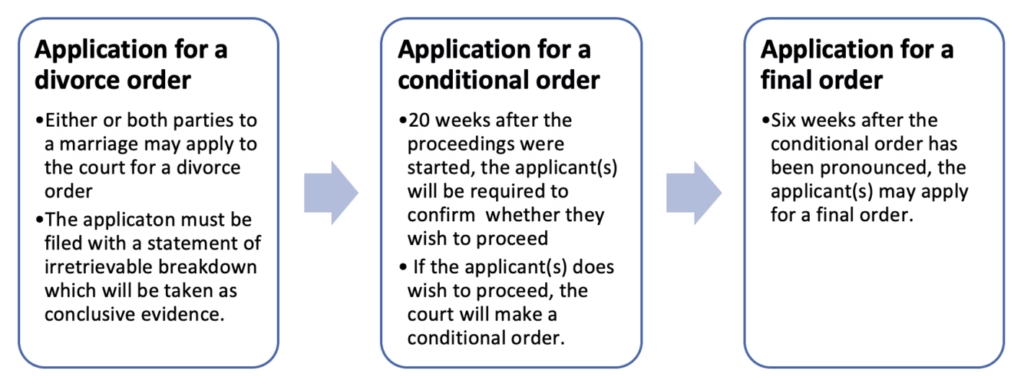
The most significant change to the legislation is that the petitioning party will no longer need to establish fault. The new law allows one party, or a couple, to jointly petition for divorce, which will be achieved by making a statement of irretrievable breakdown, which will not require any explanation, and which cannot be contested. 

The new legislation has disposed of the terms “decree nisi” and “decree absolute” and introduced plain English terminology which is fit for the modern age. The decree nisi will now be the “conditional divorce order” and the decree absolute the “final divorce order”.

No Fault Divorce Law Changes

  • The requirement to meet one of the ‘five facts’ is removed, and the parties will only be required to produce a statement of irretrievable breakdown.
  •  It is no longer be possible for a spouse to contest the divorce, even if only one party believes that the marriage has irretrievably broken down.
  • Either one party, or a couple, are able to jointly petition for divorce.
  • The new legislation has disposed of the terms “decree nisi” and “decree absolute” and introduced plain English terminology which is fit for the modern age. The decree nisi will now be the “conditional divorce order” and the decree absolute will be the “final divorce order”.
  • An extended minimum timeframe of 20 weeks has been introduced, which is intended to allow the divorcing couple to have a period to reflect on the decision to end the marriage.

The procedure:

Conclusion

The introduction of The Divorce, Dissolution and Separation Act 2020 allows parties to have an amicable separation without the need of assigning blame. This encourages a non-confrontational approach, which will set the precedent for how parties approach other aspects of the separation, including any child arrangements and financial settlement.   As such, it has been very widely welcomed by the profession. 

At TV Edwards, we believe that this will make a real difference both to the harmful conflict that fault-based divorce encourages and to the cost to individuals of obtaining a divorce, as the new procedures will be much more accessible.

The changes will also bring to an end the small number of contested divorce proceedings, where one party either seeks to prevent the divorce from happening at all (as Mr Owens did), or tries to “cross petition”, effectively saying that the divorce should be granted to them, and for different reasons. Contested divorce proceedings are generally expensive and can increase the costs of obtaining a divorce from a few hundred to many thousands of pounds. For that reason, TV Edwards welcomed this development as a great improvement for our clients.

Divorce Help With TV Edwards 

Here at TV Edwards, we have specialist divorce lawyers who are here to help you through all legal areas of the divorce process, including family financeschildcare agreements and more. 

If you are considering applying for a divorce and want to discuss the right option for you, please contact our family team on family@tvedwards.com or 020 3440 8092.

Related Services: