
The Decision
The Soho Society is a non-profit organisation established in 1972, which is funded by Westminster Council and aims to “preserve the character of Soho” and protect the interests of residents and businesses in the area. The group retains a formal consultative role to Westminster Council in relation to all planning and licensing applications in Soho.
Following the group’s annual general meeting in the final week of May 2026, it has made a decision to object to all new licence applications, applications to renew existing licences and applications for venues to stay open beyond “core hours,” which end at 11pm in Westminster.
With consideration of cumulative impact and licensing objectives, the Soho Society has specified that it will object to:
- all applications that wish to trade beyond defined core hours
- all new applications for betting shops, bars, music, dance and nightclub premises
- sex shop licences
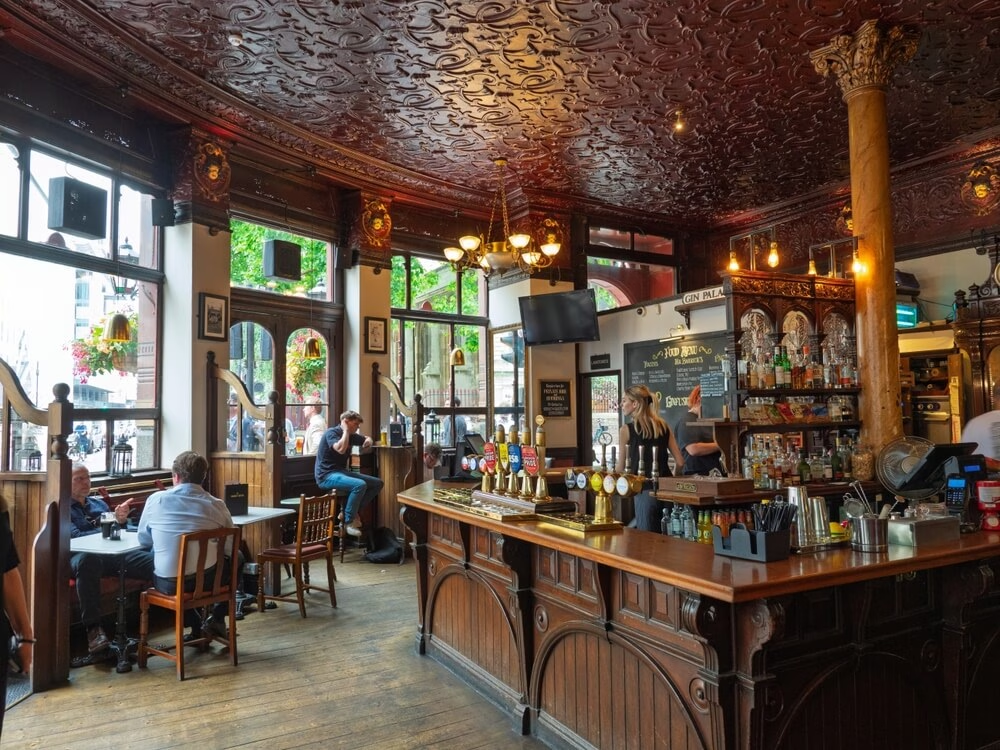
The Soho Society claims that the decision was made to prevent public nuisance and crime and disorder due to the dense concentration of late-night premises in the Westminster area. However, restaurant and bar owners have expressed concerns that this could undermine the identity of Soho, which is widely considered one of London’s most culturally rich and vibrant neighborhoods. Many have complained that it is difficult to find places to have a meal and drink in central London after 11pm due to the “core hours” policy. Club owners in the area are also reportedly being refused licences to stay open late and are required to close around 1am.
Furthermore, there have been concerns that the Soho Society’s decision could contribute to a decrease in hospitality jobs and exacerbate the current issue of high levels of youth unemployment in Britain by leading to reduced hours and jobs for young people.
The Soho Society has been accused of making vexatious and biased complaints in relation to licence applications. Although a spokesperson for the group has stated that its concerns are a reflection of people in the community, the group is estimated to only represent a minor percentage and demographic of the district’s residents.
The Draft London Strategic Licensing Policy 2026-2031
In February 2026, Sadiq Khan, the Mayor of London, set out a new London-wide Strategic Licensing Policy to boost the capital’s hospitality and nightlife industries. The policy aims to make licensing more transparent and consistent across London and provide new powers to the Mayor through the Licensing Act 2003 (to be amended by the English Devolution and Community Empowerment Bill).
Currently, all local authorities in England and Wales are required by the Licensing Act 2003 to prepare and publish a Statement of Licensing Policy establishing the principles and guidelines the authority will use when making decisions on licensing applications, highlighting the fragmented nature of the UK’s licensing framework. This means it is easier to acquire or amend a licence in some areas than in others. The new policy will establish principles that the 33 London boroughs will be required to follow when making licensing decisions, reducing licensing inconsistencies and supporting economic growth across the capital.
The UK’s licensing framework is largely focused on economic growth and high street regeneration and balancing this alongside public safety and the statutory licensing objectives which are prevention of crime and disorder, public safety, prevention of public nuisance and protecting children from harm. The Revised Guidance issued under Section 182 of the Licensing Act 2003, also imposes a duty on local authorities to have regard to economic growth, stating, “When making licensing decisions, all licensing authorities should consider the need to promote growth and deliver economic benefits”.
The Soho Society’s decision to challenge new licence applications seemingly misaligns with the goals set out in the new licensing policy, which is why it is being met with objections.
The Mayor of London’s Plan to Overrule the Soho Society’s Decision
Most notably, the Mayor of London has vowed to overrule the Soho Society’s plan to object to all new licence applications in Soho.
The new powers the Mayor will be granted by the government detailed in the Draft London Strategic Licensing Policy 2026-2031 are set to be fully implemented by the summer of 2026. This is significant as it will be the first time the Mayor has a formal strategic role in London’s licensing system. He has stated that he will use these new licensing powers to help “protect venues” and “extend London’s late-night offer”.
Specifically, the Mayor will be consulted by licensing authorities on their Statement of Licensing Policies, be able to overturn decisions to block pubs and bars from opening and be able to determine licence applications. The Greater London Authority (GLA) is also being added as a responsible authority that can intervene in licensing decisions, and the Mayor will have the power to “call-in” or review applications in areas that are deemed to be of strategic importance to the night-time economy. This would permit bars to stay open later and increase al-fresco dining in Soho during the summertime. Al fresco dining is currently limited as the Soho Society and other residents took issue with its prominence following the pandemic.
The new licensing landscape could improve and promote equal footing among different types of operators, as Small and Medium-sized Enterprises (SMEs) and grassroots organisations are reported to be disproportionately burdened by the current system. There could also be a shift to abolish cumulative impact assessments (CIAs), which are tools that licensing authorities use to identify specific geographic zones where the high concentration of licensed premises negatively affects the local area. Furthermore, it could lead to responsibility for noise nuisance mitigation being placed on residential developers who build near existing hospitality venues.
Ultimately, these policy changes could make it easier for premises to acquire and amend licences and also prevent the imposition of blanket conditions and “core hours” policies, as each application will be assessed on its own merit.
How Our Licensing Solicitors Can Help
We provide comprehensive advice and representation on all aspects of licensing policies and licence applications:
We can help you by:
- Reviewing and interpreting local authority licensing policies
- Advising on how policies affect your application
- Preparing compliant and strategically structured licence applications
- Representing you in licensing hearings and negotiations
- Justifying applications that deviate from licensing policies
- Helping protect your licence from review or revocation
We act for a wide range of businesses, including restaurants, bars, pubs, nightclubs, event venues, and hospitality operators. Our solicitors routinely deal with contested applications in Soho and across London, and are specialists in negotiating with responsible authorities, residents’ associations and neighbouring properties to seek a compromise and ensure a suitably licence is obtained.
Why Choose TV Edwards?
- Highly ranked in legal directories – Legal 500 and Chambers UK
- Immediate emergency support – call us on 0203 440 8000
- Specialist representation – police station advisers, solicitors, and higher court advocates
- Hardworking problem-solvers – we fearlessly challenge evidence, protecting your interests
- Honest and down-to-earth – we explain your options compassionately and in plain English