
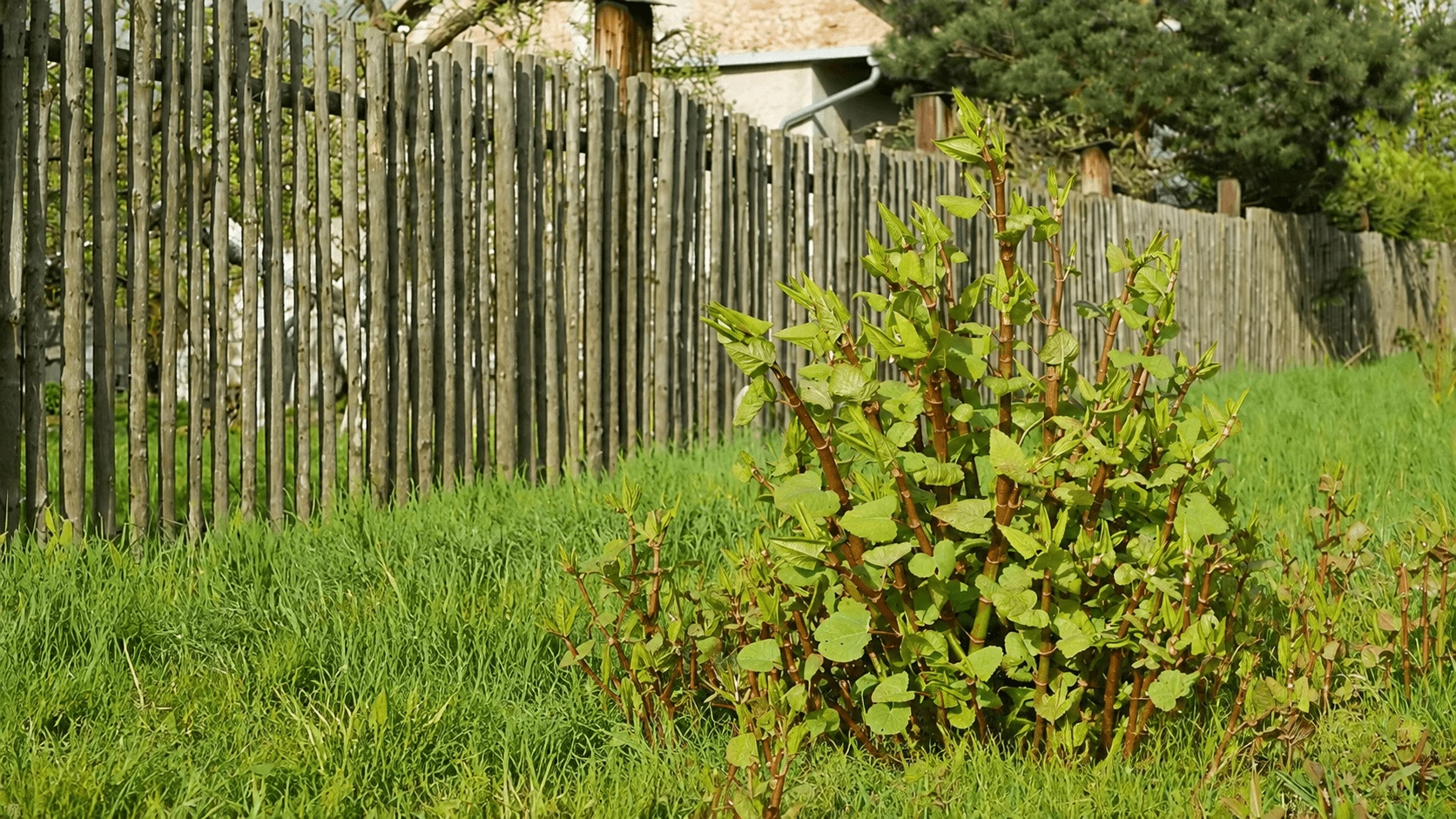

Finding Japanese knotweed growing in your garden can be alarming. Often, homeowners are unsure what to do next. Should you remove it? Do you need to tell your neighbour? Who is responsible for the cost of treatment? What happens if the knotweed has spread from somewhere else?
Before taking action, it is important to understand where the knotweed may have come from and what your legal position may be.
What is Japanese knotweed?
Japanese knotweed is an invasive non-native plant which can spread through an extensive underground system of stems known as rhizomes.
For homeowners, the problem is not necessarily limited to the plants that can be seen above ground. The rhizome system may extend beyond the visible growth and, in some cases, across property boundaries.
Japanese knotweed can therefore become both a treatment issue and a legal issue, particularly where it has spread between neighbouring properties.
Can I remove Japanese knotweed myself?
If you discover Japanese knotweed, your first reaction may be to cut it down or dig it out.
That can create further problems.
There are specific rules concerning the handling and disposal of Japanese knotweed. Once removed, Japanese knotweed material may constitute controlled waste and its disposal is regulated.
In practice, specialist treatment is normally the sensible approach. Treatment may involve a programme lasting several years, depending on the extent of the infestation and the method used.
There is, however, another important step to consider before treatment begins.
If there is any possibility of a dispute about where the knotweed came from, consider having the infestation independently surveyed and documented before it is treated.
Why should I obtain a Japanese knotweed survey?
One of the most important questions in a knotweed dispute is often:
Where did it come from?
A specialist may be able to examine the infestation and provide an opinion on matters such as its extent, maturity, likely direction of spread, evidence of previous treatment and, where possible, its probable origin.
This is an important evidence in a knotweed dispute.
For example, knotweed found in your garden may have originated from neighbouring land. Alternatively, it may have originated within your property and spread towards your neighbour.
Those two situations can have very different consequences.
Treatment can also change the physical evidence available for inspection. If there is a realistic prospect of a dispute, it is therefore sensible to consider obtaining appropriate expert evidence before the infestation is materially disturbed.
What happens if the knotweed came from my neighbour’s property?
If Japanese knotweed has spread from neighbouring land onto your property, there may potentially be a claim in private nuisance.
Japanese knotweed encroachment has been considered in Network Rail Infrastructure Ltd v Williams [2018] EWCA Civ 1514. The presence of knotweed rhizomes can constitute a physical interference with a person’s use and enjoyment of their land.
That does not mean that the mere presence of Japanese knotweed next door automatically gives you a claim. The evidence you have i.e any surveyor reports will matter.
Questions may include where the infestation originated, when the neighbouring owner became aware of it, what steps they took to control it, whether it actually spread onto your land and what loss you have suffered as a result.
This is why establishing the likely origin and direction of spread at an early stage can be so important.
What happens if the knotweed came from my property?
The position can work the other way around.
If Japanese knotweed originates on your land and spreads onto neighbouring property, you may potentially face a private nuisance claim if the circumstances establish liability.
Once you become aware of the problem, simply ignoring it can therefore create further risk.
Obtaining professional advice and putting an appropriate treatment programme in place may be important, not only to protect your property but also to demonstrate the steps you have taken to control the infestation and prevent further spread.
This is another reason why determining the likely source of the knotweed matters. A specialist report may be relevant not only when pursuing a claim against somebody else, but also when protecting your position if an allegation is made against you.
What if the knotweed came from council land or another public area?
Sometimes the suspected source is not another homeowner.
Knotweed may be growing on council-owned land, railway land, an alleyway, an unadopted road or another area where ownership is not immediately obvious.
The first question may therefore be: who owns or controls the land?
That may require investigation of the registered titles and other property documents before responsibility can properly be considered.
The courts have considered claims involving Japanese knotweed spreading from public land. In Davies v Bridgend County Borough Council [2024] UKSC 15, the knotweed had spread from council-owned land.
The Supreme Court’s decision also demonstrates an important point: establishing a breach does not necessarily mean that every loss claimed will be recoverable. The claimant must still establish the necessary causal connection between the breach and the particular loss claimed.
Where the suspected source is public or third-party land, identifying the owner and obtaining appropriate expert evidence can therefore be crucial before deciding what action to take.
What if I only recently bought the property?
There is another potential issue where Japanese knotweed is discovered after purchasing a home.
The seller’s replies during the conveyancing process should be reviewed carefully.
The Law Society’s TA6 Property Information Form contains a specific question concerning Japanese knotweed. Depending on the version of the form used and the answer given, there may be circumstances in which a purchaser considers whether the seller made a misrepresentation about the presence of knotweed.
Relevant documents might include the TA6 form itself, previous surveys, historic photographs, treatment records, guarantees, invoices and correspondence involving the seller, estate agent or conveyancers.
An expert’s opinion about the apparent age of the infestation or evidence of previous treatment may also be relevant.
However, the fact that Japanese knotweed is discovered after completion does not, by itself, establish that the previous owner is liable.
Should I wait for the legal dispute to be resolved before treating the knotweed?
Not necessarily.
Treatment and the legal investigation can often progress alongside one another.
The important issue is to preserve appropriate evidence before treatment materially alters the infestation.
There may also be practical complications where the infestation extends across several properties. A treatment contractor may recommend coordinating treatment across all affected areas. However, you cannot simply assume that you are entitled to enter neighbouring land to carry out treatment.
Where several properties are affected, a coordinated approach may be sensible. Neighbours may agree to participate in the same treatment programme, with the treatment contractor providing separate quotations for the areas within each owner’s responsibility.
If ownership of part of the affected land is unclear — for example, a rear alleyway or shared access — the title position may also need to be investigated and the relevant owner’s consent sought.
How can we help?
Japanese knotweed disputes are rarely just about removing a plant. They can involve property ownership, expert evidence, treatment programmes and potential claims between several different parties.
We can assist by investigating the legal position alongside the technical evidence.
Where the knotweed may have originated from your property, we can also advise on your potential exposure and the steps that can be taken to protect your position.
Where treatment requires cooperation between several landowners, we can assist with correspondence concerning access, responsibility and coordinated treatment.
The objective is not simply to establish that Japanese knotweed exists. It is to control the infestation, preserve the evidence, understand where it came from and determine who may ultimately be responsible.
If you have discovered Japanese knotweed at your property and are unsure what to do next, please do get in touch. Contact us on 020 3440 8000 or email adam.haffenden@tvedwards.com.