

The below is intended as a brief introductory guide for aspiring solicitors who are exploring the SQE route to qualification as a solicitor. I have previously written about the first part of the SQE exam – the SQE1 – in an earlier TV Edwards blog.
What follows is drawn from my own experiences of the SQE2 assessment, which I passed last year at the first attempt during my training contract at TV Edwards.
SQE2: the basics
Whereas the SQE1 tests a candidate’s “functioning legal knowledge” through a gruelling ten-hour multiple-choice exam, SQE2 tests knowledge of the law and various legal skills mapped against the SRA’s Statement of Solicitor Competence.
The SQE2 consists of 16 exam ‘stations’ spread across five days. Each station tests different legal skills. Two of the assessment days entail role-playing oral assessments, the other three days are writing-only.
The stations include:
- Oral advocacy
- Client interviewing and preparation of an attendance note
- Written case analysis
- Legal research
- Legal writing and drafting
The areas of law assessed in SQE2 are broadly the same as SQE1:
- Criminal law and litigation
- Dispute resolution (contract and tort)
- Land law and property practice
- Equity and trusts
- Wills and probate
- Business law
As with SQE1, issues relating to professionalism and ethics are tested pervasively throughout SQE2.
Dates of the assessments are listed here.
At the time of writing, the cost to sit SQE2 is £2,974.
Most people will need to pass SQE1 before they can sit SQE2. However, if you have already passed the LPC (or meet other transitional requirements), you might be able to use qualifying work experience plus the SQE2 to replace the need for a training contract (see this page for more information about this process).
How is SQE2 marked
The SQE2’s Marking and Standard Setting Policy is complicated, but in the simplest terms, the assessor will score candidates between 0 and 5 for various skills and their correct and thorough application of the law. In contrast to the objective nature of the SQE1’s marking, SQE2 is graded via the subjective professional judgement of the assessor. There are limited grounds to appeal one’s marks.
On results day, candidates will be provided with a full breakdown of their marks across each of the sixteen stations, and results will be broken down into charts that look like this:
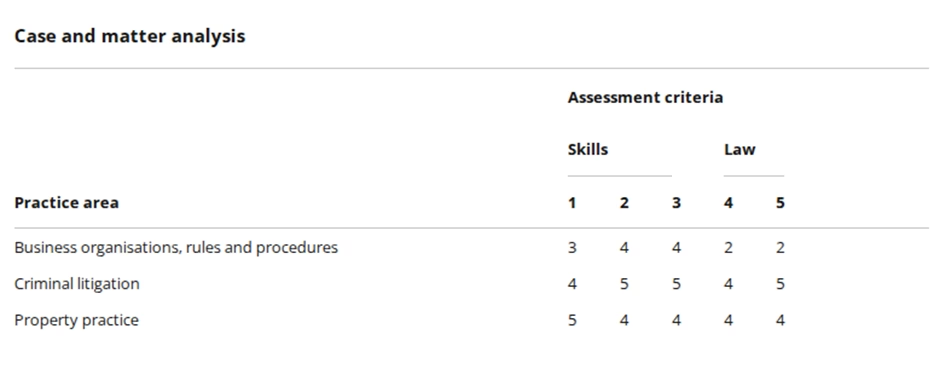
The full list of skills criteria relating to each station can be found here. Examples of skills that candidates will be assessed against include:
- Listening to the client and using questioning effectively to enable the client to tell the solicitor what is important to them
- Providing client-focused advice (i.e advice which demonstrates an understanding of the problem from the client’s point of view and what the client wants to achieve, not just from a legal perspective)
- Using appropriate language and behaviour
- Presenting a persuasive argument
- Identifying and use relevant sources and information
- Structuring the document appropriately and logically
It is possible to score marks for skills whilst not applying the law correctly, and likewise, it’s theoretically possible to score marks for one’s correct application of the law whilst not doing well on skills. This might provide some comfort to candidates as it means that drawing a blank on the law may not be fatal, but it is naturally more difficult to gain skills marks without having some confidence in the underlying law.
Preparing for SQE2
If you are currently working in a legal role then you’re most likely already developing some of the skills required to pass SQE2. However, in my view it is essential to enrol onto a course with proper training materials and good mock exams in order to pass SQE2.
As with SQE1, preparing for SQE2 will require time, consistency, and dedication. Juggling SQE2 preparation with a full-time job and any other responsibilities will be a challenge for most people.
I sat SQE2 nearly three years after SQE1. This meant a lot of my initial focus for SQE2 was re-learning and memorising the vast curriculum of ‘black letter law’ that was tested in SQE1. I know some candidates sit SQE2 very soon after passing SQE1, and in hindsight this approach has clear advantages, as the underlying law should be ‘fresher’ meaning efforts can focus on honing skills and learning the format of the stations.
A lot has been made of the difficulty and low pass-rate of SQE1, but the SQE2 is also a very tough exam. The SQE2’s pass rate is significantly higher than SQE1 (which, again, should provide some comfort) but SQE2 is still a demanding test of memory and skills under intense time pressure, and it requires significant preparation.
SQE2 is a completely closed-book exam, meaning (unlike solicitors!) you will have to advise your client without being able to check the law. In SQE1, you pick the correct answer from a list, while in SQE2, the right answer is not placed in front of you. I may be in the minority, but I personally found SQE2 to be more challenging than SQE1.
Tips for success
- Leverage social networks to learn from other peoples’ experiences. While social media posts about the SQE often relate to the stress and anxiety of the experience, there is also a lot of useful insight out there. If you can block out the negativity, I found reddit to be a great source of SQE information.
- Be familiar with the skills being assessed and the marking criteria of each station. The SQE2 marking system can seem labyrinthian, but if you understand what the assessor is grading you on, you can focus your efforts in the right places.
- Start preparation early. Create a study plan and stick to it. Don’t expect to have much of a social life until it’s over – celebrate afterwards!
- Mocks, mocks, mocks. As with SQE1, it’s crucial to know what to expect on the day, and to be comfortable with the format and layout of the different stations.
- Be confident, not complacent. If you’re sitting SQE2, you’ve most likely got through SQE1, and statistically, that’s the hardest part. But don’t rest on your laurels, because SQE2 represents a different type of challenge.
Passing SQE2 and qualification
After confirmation of passing SQE2, and registering two years’ qualifying work experience, all that typically remains before being admitted to the roll of solicitors is to pass the SRA’s character and suitability requirements.
I was able to complete this process within days of receiving my results, and before I knew it I was starting my new role in TV Edwards’ fantastic social welfare team as a qualified solicitor.
Disclaimer: The information on the TV Edwards website is for general information only and reflects the position at the date of publication.